Influencer outreach dashboard template for Shopify brands
Build an influencer outreach dashboard template that tracks creator pipeline, gifting, post rate, engagement, attribution, and affiliate conversion across every stage of a Shopify seeding program.

An influencer outreach dashboard template is the difference between a gifting program that generates auditable ROI data and one that generates a folder of screenshots and a gut feeling.
At 20 sends per month, most teams can track what they need in their heads. At 50, the data starts falling through the cracks. At 100, a program without structured tracking produces numbers nobody trusts.
The six-module framework below covers every tracking layer a Shopify-based gifting program needs - from creator pipeline status through to downstream attributed revenue - and specifies the exact fields, update cadence, and status logic for each one.
What an influencer outreach dashboard template actually needs to track
An influencer outreach dashboard template for Shopify brands needs to cover six distinct data layers that operate on different timelines and feed different decisions.
Most brands track only one or two of them - typically send status and post rate - and miss the layers where the most actionable data lives.
According to Aspire's influencer marketing data, brands with documented tracking systems report 3x higher affiliate conversion rates from gifting programs than those operating without structured dashboards.
The variable driving that gap is follow-up timing: teams with systematic dashboards act on pipeline candidates within the 90-day window; teams without them act months later, when the conversion window has already closed.
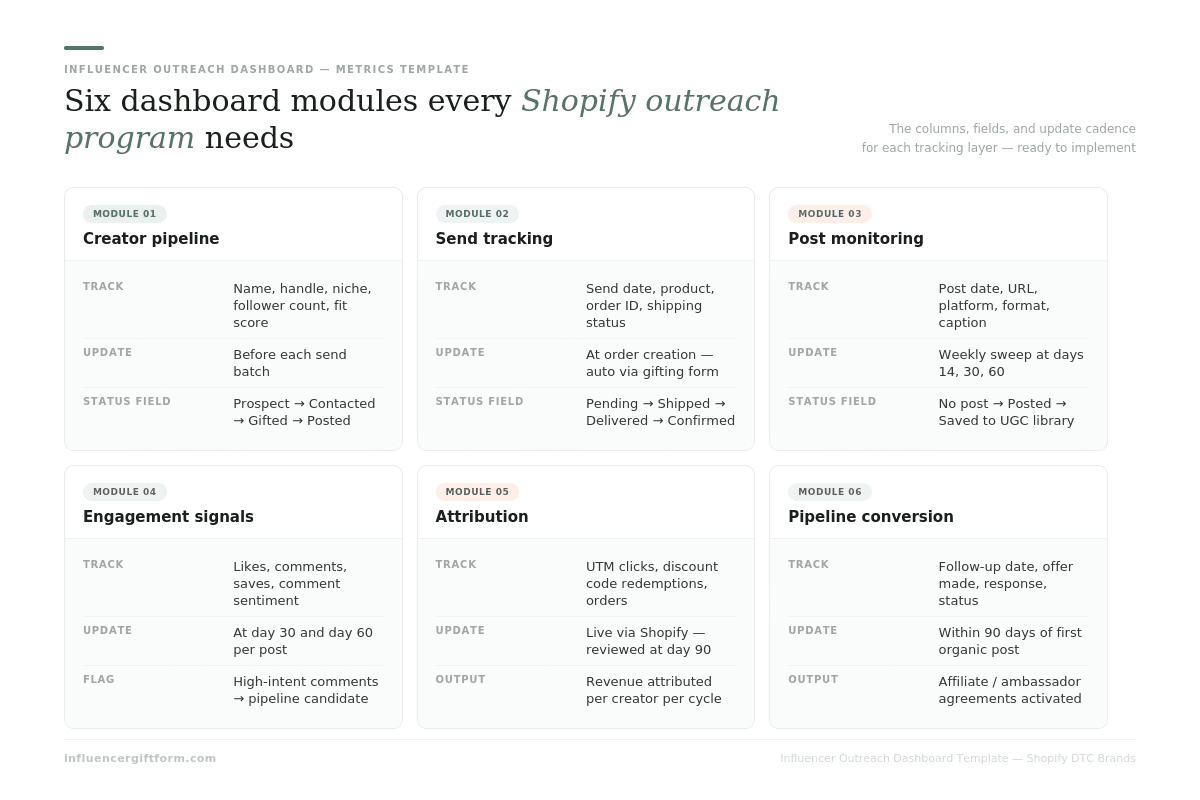
The template below maps to the product seeding workflow at every stage - from prospecting through to revenue attribution.
Module 1: the creator pipeline - status before the send
The creator pipeline module tracks every creator from initial identification through to gifted status. The fields that matter: handle, platform, niche, follower count, fit score, and a four-stage status field - Prospect, Contacted, Gifted, Posted.
The fit score is the most important field in this module and the one most dashboards omit. Assigning a score at the prospect stage - based on niche fit, engagement quality, and posting consistency - creates a feedback loop between program outcomes and selection criteria.
Creators who scored high and posted at high rates validate the criteria. Creators who scored high and did not post signal a mismatch worth investigating.
For brands building their scoring criteria from scratch, this micro-influencer scoring system guide covers the five signals and weighting framework that produce the most reliable post rate predictions.
Module 2: send tracking - order data linked to creator records
The send tracking module is responsible for storing the operational data behind every gifting send. That includes:
Send date
Product and variant shipped
Shopify order ID
Shipping and fulfillment status
The most important decision in this module is how the data gets updated.
At low volume, manual entry is usually manageable. A team sending 10 to 20 packages per month can still update spreadsheets without creating major reporting issues. But as volume increases, the delays start compounding.
Once a program reaches 50+ sends per month, the gap between shipment and dashboard entry begins creating attribution problems. Orders get logged late, creator records become incomplete, and post-send reporting loses reliability.
The scalable solution is automatic order creation tied directly to the gifting workflow.
Instead of manually creating records after the shipment happens, the system generates a $0 Shopify order the moment a creator submits their address and product preferences through a gifting form. That order ID is instantly linked to the creator profile without requiring manual input from the team.
With Influencer Gift Form, this process happens natively inside the platform:
Every form submission creates a $0 Shopify order automatically
Creator, product, and order data are logged in one centralized dashboard
Send tracking updates in real time
Attribution records stay connected from the start
The result is a tracking system that updates at the moment the order is created - not hours or days later when someone eventually enters the data manually.
Module 3: post monitoring - the 14/30/60 sweep cadence
The post monitoring module records organic content generated by gifted creators: post date, URL, platform, format, and whether the content has been saved to the UGC library.
The update cadence that works in practice is a weekly sweep at three checkpoints - days 14, 30, and 60 after each send.
Day 14 catches fast posters. Day 30 captures the majority of organic posts across most product categories. Day 60 closes the window and produces the final post rate number for that send cohort.
Any creator who has not posted by day 60 is removed from the active pipeline and marked inactive for future send consideration.
The UGC library flag in this module is what enables the shoppable UGC repurposing pipeline.
Every post marked "Saved to UGC library" becomes a candidate for paid ad creative, email assets, and product page content - assets that consistently outperform studio-produced creative when tested against a baseline.
Module 4: engagement signals - reading the comment layer
The engagement signals module goes one layer below post rate. Fields: likes, comments, saves, and a comment sentiment field that flags posts where the comment section shows purchase-intent signals - questions about where to buy, friend tags, and direct expressions of interest.
This module updates at day 30 and day 60 per post, not at post publication. Engagement data read immediately after a post often reflects the creator's existing audience before algorithmic distribution has run its course. Reading it at day 30 produces more stable signal.
The comment sentiment field is the most operationally important field in this module.
Creators whose posts generate high-intent comments are the pipeline candidates worth prioritizing in Module 6 - their audiences have already indicated conversion readiness, which makes the affiliate or ambassador pitch significantly warmer.
For context on what strong engagement benchmarks look like by platform and niche, this guide on what is a good CPM covers related performance reference points.
Module 5
6: attribution and pipeline conversion
The attribution module tracks the revenue data that makes program ROI auditable: UTM link clicks, discount code redemptions, and orders attributed to each creator.
This module runs live via Shopify and is reviewed at the day 90 milestone for each send cohort. The output is a revenue-per-creator figure for the program cycle - the number that converts all upstream metrics into a budget justification.
For this module to work, UTM parameters and unique discount codes must be assigned at the time of gifting confirmation, not added retroactively.
A code assigned after a creator has already posted cannot attribute the conversions that post generated. The attribution module is only as good as the pre-send tracking setup.
The pipeline conversion module closes the loop. It records the follow-up date, the offer made, the creator's response, and the current status of any affiliate or ambassador agreement.
The target is contact within 90 days of the first organic post - the window in which creator interest and product experience are both still active.
Brands that systematize this step consistently report pipeline conversion rates 4–6x higher than those following up on an ad hoc basis.
For brands formalizing these relationships, this guide on influencer agreement contracts covers the structure that protects both parties.
Building the dashboard inside Shopify's existing data structure
The six modules above can be managed in a structured spreadsheet when send volume is still low.
But once a program reaches 50+ sends per month, manual workflows usually become the bottleneck - especially for attribution tracking, delivery logging, and real-time reporting.
At that stage, a dedicated tool connected directly to Shopify becomes the more reliable setup because it eliminates manual data entry and keeps the tracking system updated automatically.
Here’s what changes with a purpose-built infrastructure:
Send tracking updates in real time
Attribution data syncs directly with Shopify orders
Creator and product records stay centralized
Post-send performance becomes easier to analyze
Teams avoid maintaining large manual spreadsheets
Influencer Gift Form handles the infrastructure for Modules 2, 3, and 5 natively. The gifting form automatically creates the $0 Shopify order, logs creator and product information, and connects every shipment to Shopify order history for attribution analysis later.
For brands comparing tools before scaling:
This breakdown of GRIN alternatives explains which tracking capabilities matter most as gifting volume grows.
This Shopify gifting case study shows what a fully connected tracking stack looks like in practice.
Start a free trial of Influencer Gift Form and connect the first three dashboard modules directly to your Shopify data - without manually building a single spreadsheet row.