How to scale influencer gifting to 100 creators per month
Learn how to scale influencer gifting from 20 to 100+ monthly sends using automated Shopify workflows, creator tracking, UGC systems, and structured pipeline conversion processes.

How to scale influencer gifting is a question most DTC brands hit between month two and month four of a seeding program - right after the first send proved the model works and right before the operational reality of doing it at volume sets in.
The jump from 20 to 100 sends per month is not a marketing problem. It is an infrastructure problem.
Every decision that was manual at 20 sends becomes a bottleneck at 60, and a program that runs on DM threads and copy-pasted Shopify orders will collapse before the data has time to compound.
How to scale influencer gifting: the five operational stages
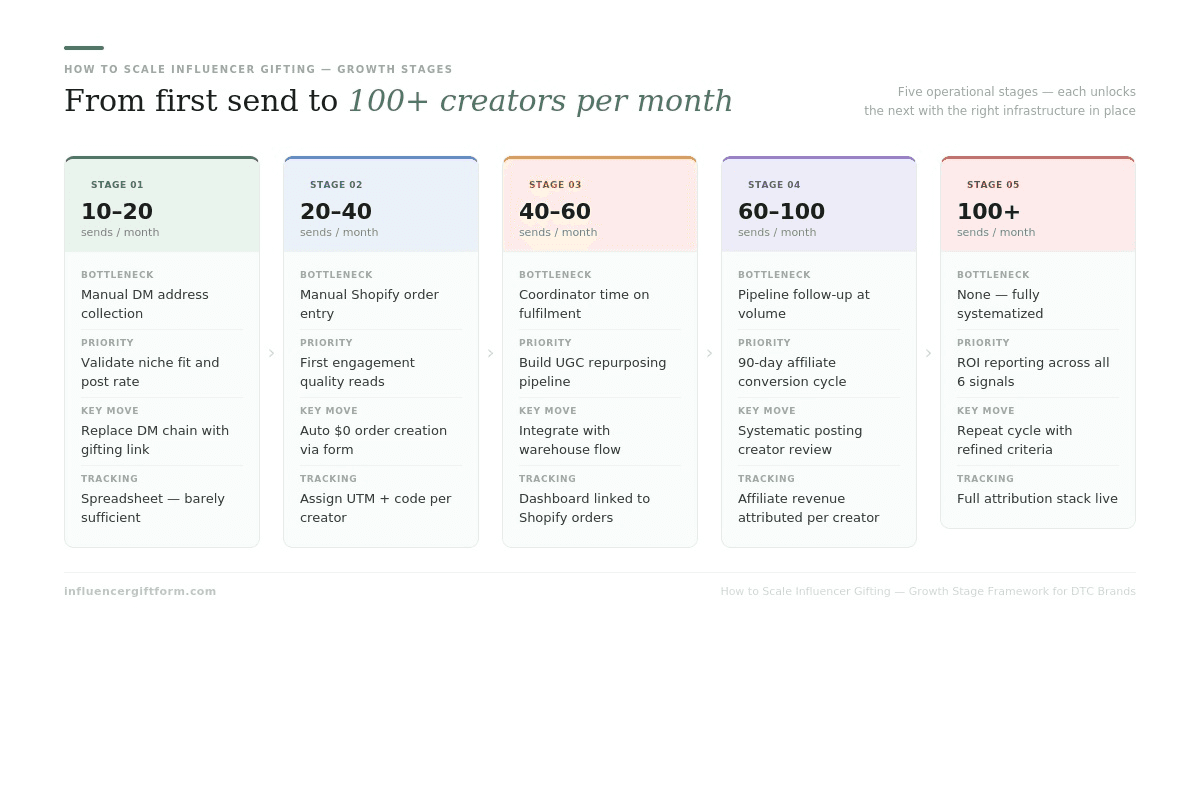
How to scale influencer gifting past 100 monthly sends requires moving through five distinct operational stages, each with its own primary bottleneck and the specific fix that unlocks the next stage.
Trying to jump from Stage 1 to Stage 5 without addressing the intermediate constraints is the reason most programs stall.
According to Influencer Marketing Hub's 2024 benchmark report, brands running structured gifting programs at 100+ sends per month generate returns 11x higher than ad-hoc programs at comparable spend.
The scaling curve is steep, but the inflection point is almost always operational rather than strategic.
Stage 1 to Stage 2: replace the DM chain before anything else
At 10–20 sends per month, the primary bottleneck is address collection.
Most programs at this stage run on direct messages - the team reaches out, waits for a response, asks for address and size preferences, waits again, and manually enters the data into Shopify.
It works at 20 sends. It consumes disproportionate coordinator time at 30. The fix that unlocks Stage 2 is replacing the DM chain with a secure gifting link.
The creator opens a branded form, selects product preferences, and submits their shipping address in a single step. No back-and-forth.
No data entry on the brand side. This single change is what allows volume to increase without proportional headcount.
Influencer Gift Form was built specifically for this transition. A branded gifting link is sent to each creator - the form captures all the information needed to fulfill the order, and a $0 Shopify order is created automatically from the creator's submission.
For brands still in Stage 1, this is the highest-leverage operational change available before scaling anything else. Without stable infrastructure, increasing send volume usually increases chaos faster than performance.
At Stage 2, typically between 20 and 40 sends per month, the priority shifts toward reading the first meaningful engagement quality signals.
Which creators are consistently posting.
What the audience comment patterns actually look like.
Which creator relationships are worth developing into longer-term partnerships.
This is also the point where tracking infrastructure needs to mature alongside the program itself. UTM parameters and unique discount codes should be assigned per creator before the next send batch goes out, so the brand can begin connecting creator activity to measurable traffic and conversion behavior instead of relying only on post counts.
Stage 2 to Stage 3: integrate with the warehouse flow
Between 40 and 60 sends per month, coordinator time on fulfilment becomes the binding constraint.
Even with a gifting link in place, a program at this volume requires someone managing product selection, order confirmation, and shipment tracking across dozens of active sends simultaneously.
The fix is integrating the gifting form directly with the existing Shopify warehouse flow.
When the $0 order is created automatically from the creator's form submission, it enters the same fulfilment pipeline as any paid order - the warehouse team processes it without a separate manual step.
No custom packaging list. No parallel spreadsheet.
At this stage, the UGC content library should also be taking shape. Every organic post from a seeded creator represents a creative asset worth capturing - tagged by creator, platform, format, and post date.
Brands that systematize this step at Stage 3 arrive at Stage 4 with a repurposing pipeline already running, rather than scrambling to build it retroactively.
For brands deciding which products generate the highest post rates at this volume, this breakdown of gifts for influencers by category is a useful filter before expanding the send list.
Stage 3 to Stage 4: systematize the 90-day pipeline review
At 60–100 sends per month, the primary bottleneck shifts from fulfilment to pipeline follow-up.
The program is generating enough organic posts that the list of creators worth approaching for affiliate or ambassador programs is substantial - but following up with each one manually, within the 90-day window when conversion rates are highest, is genuinely difficult without a system.
The fix is a structured 90-day pipeline review cadence built into the tracking dashboard. At the time of each send, a 90-day follow-up reminder is set. At the review, the team looks at post status, engagement quality, and attribution data for each creator in the cohort - and contacts the ones who posted with strong signal.
This is also the stage at which micro-influencer platforms become worth evaluating. Some tools include pipeline CRM features that make the 90-day review process significantly less manual at this volume.
For brands comparing options, this GRIN alternatives breakdown covers how purpose-built seeding tools differ from all-in-one platforms on the specific workflows that matter at Stage 3 and Stage 4.
Stage 4 to Stage 5: full systematization at 100+ sends per month
A program that has already cleared the first four stages, with the gifting link in place, warehouse integration live, UTM tracking active, and a 90 day pipeline review process running, can reach 100+ sends per month without the operational overhead that kills most programs before they scale.
At Stage 5, the focus shifts away from setup and toward multi-layer ROI visibility.
Post rate.
UGC volume.
Engagement quality.
Repurposing performance.
Pipeline conversion rate.
Downstream attributed revenue.
At this point, all six signal layers are generating meaningful data within each 90 day cycle. The program is no longer being managed through intuition or isolated campaign metrics. It can now be optimized with precision.
This is also where the compounding effect of high-volume seeding becomes fully visible. Strong creators feed the affiliate pipeline, successful content improves repurposing performance, and accumulated engagement data makes future creator selection more accurate over time.
Brands running 147 sends per month - the average among high-growth DTC brands, per Influencer Marketing Hub - report post rates of 42% and pipeline conversion rates of 18%, compared to industry averages of 19% and 3% respectively.
The gap is almost entirely explained by volume generating better selection data, which feeds back into more qualified creator lists on the next cycle.
For brands looking at the full strategic context of where gifting sits relative to other acquisition levers, this overview of ecommerce growth strategies for Shopify puts the creator channel in the right frame.
Why the operational constraint is the scaling constraint
Every stage of this framework points to the same underlying principle: the ceiling on a seeding program is almost always operational before it is strategic.
Creator selection criteria can be refined. Outreach messaging can be tested. Product mix can be optimized. But none of those improvements matter if the team is still spending hours every week manually entering addresses and building Shopify orders one at a time.
Influencer Gift Form removes that operational ceiling at every stage.
The gifting link handles address collection automatically.
Automatic $0 order creation removes manual Shopify work.
The per creator tracking dashboard, connected directly to Shopify order history, makes attribution possible without additional tooling.
The system scales from 20 to 200+ monthly sends without requiring additional headcount.
That operational stability is what allows the strategic side of influencer marketing to finally compound. Instead of spending time managing logistics, teams can focus on improving creator quality, analyzing performance signals, and building long term revenue pipelines from the creators already engaging with the brand.
This Shopify gifting case study shows what the full operational model looks like for a real DTC brand that has cleared all five stages. And for brands just beginning the transition from Stage 1, the workflow automation guide covers the specific time savings at each volume threshold.