Why influencer marketing is important for DTC brands in 2025
How influencer marketing drives UGC, organic reach, brand trust, and recurring revenue for DTC brands through highly aligned creator partnerships.
Why influencer marketing is important is a question most DTC brands answer incorrectly - by pointing at post counts and follower reach.
Those are the least valuable outputs a gifting program produces, and building a budget case around them is exactly why so many programs get cut after one cycle.
A gifting send to 60 well-selected creators generates five distinct streams of value simultaneously: organic content that costs nothing to produce, audience impressions without paid media spend, and paid ad creative that often outperforms studio production.
It also drives affiliate revenue from creators who become long-term partners, while creating third-party trust signals that paid ads simply cannot replicate.
The organic post is just the visible surface of that return.
Why influencer marketing is important: the five value streams most brands only count one of
Why influencer marketing is important comes down to a measurement problem as much as a channel problem.
Most brands track the channel through a single output - the post - and miss the four other value streams the same send generates simultaneously.
According to Influencer Marketing Hub's 2024 benchmark report, the influencer marketing industry is projected to reach $24 billion in 2024, up from $16.4 billion in 2022.
That growth does not reflect brands paying more for posts - it reflects a broader recognition that the return on creator relationships compounds across multiple channels at once.
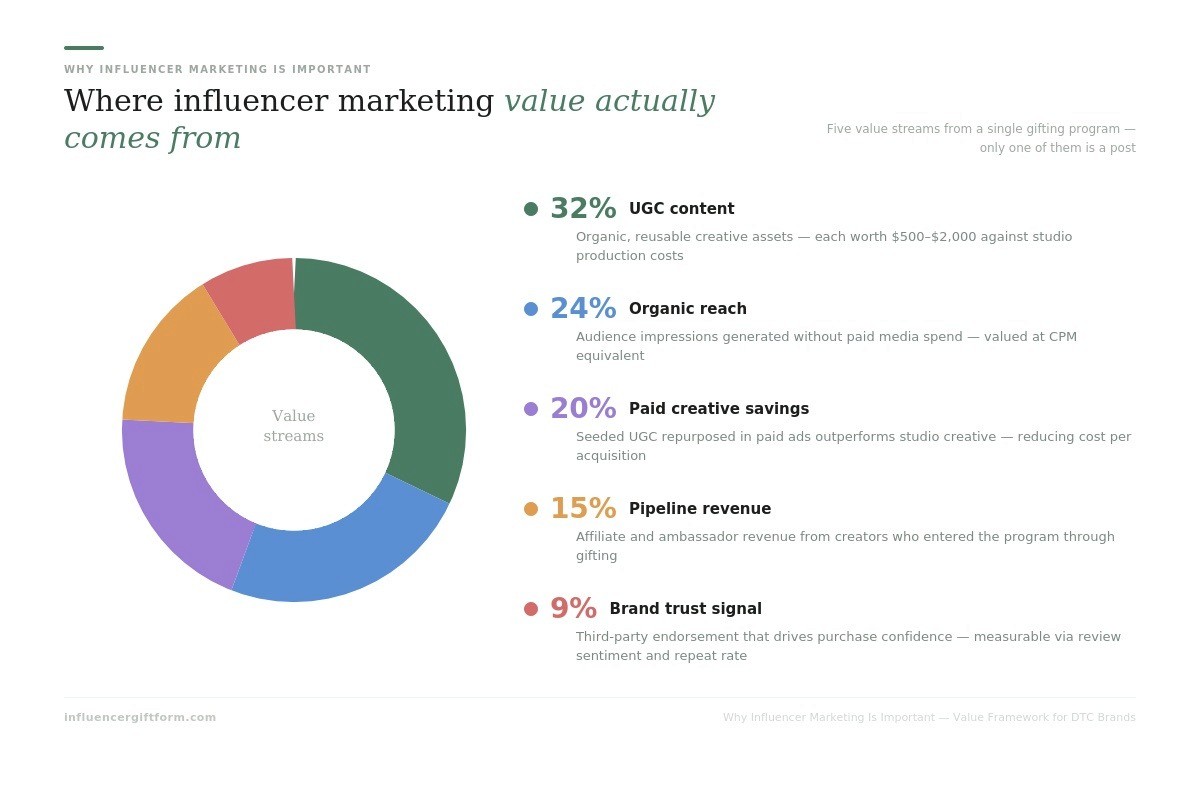
The five value streams a structured product seeding program generates, and the share of total program value each represents, are mapped in the infographic below.
UGC content: the asset most brands undervalue by a factor of ten
The most tangible output of a gifting program is organic creative content - and it is almost always undervalued in program ROI calculations.
Each piece of usable UGC (user-generated content) produced through seeding has a direct cost-equivalent against agency or studio production, typically between $500 and $2,000 per asset depending on format and platform.
A seeding program that sends to 60 creators and generates a 35% post rate produces 21 pieces of content.
At a conservative $500 per asset, that is $10,500 in creative value - from a program that may have cost $3,600 in product at $60 per send.
That math does not appear in most post-campaign reports because most teams are not counting it.
Beyond the production cost savings, shoppable UGC from gifting campaigns consistently outperforms studio-produced creative when repurposed as paid ad assets. ‘
The authenticity of the original context - a real person who actually received and used the product - travels with the content into paid placements.
Click-through rates on repurposed seeded UGC run 20–50% higher than equivalent studio assets across categories, according to data from Stackla's consumer content report.
For DTC brands running paid social at scale, that delta has a direct impact on cost per acquisition.
Organic reach: impressions without a media budget attached
Every organic post generated through a seeding program delivers audience impressions at zero paid media cost.
When valued at the CPM (cost per thousand impressions) equivalent of paid social placements in the same category, organic reach from a mid-size creator program represents tens of thousands of dollars in media value per program cycle.
According to Influencer Marketing Hub, the average earned media value of influencer content is estimated at $5.78 for every $1 spent - a ratio that holds even when the "spend" is product cost rather than a creator fee.
For a program running $3,600 in product sends per month, that translates to roughly $20,800 in equivalent media value.
The reach calculation matters most when a brand is comparing influencer gifting to paid social as a line item.
A micro-influencer in the 10K–50K range with high engagement quality delivers audience impressions at an effective CPM that paid social rarely matches - and those impressions arrive with a third-party recommendation attached, which changes how the audience processes them.
Pipeline revenue: why the gifting program is also a recruiting funnel
The least understood value stream in influencer marketing is often the one that generates the most durable revenue over time.
Creators who receive product, choose to post organically, and drive genuine audience engagement become the strongest affiliate and ambassador candidates because the relationship started with authentic product experience, not a transactional contract.
A gifting-to-affiliate pipeline usually works in three stages.
The seeding program identifies creators whose organic posts generate measurable purchase intent and audience response.
High-performing creators are approached within 90 days for a more structured partnership, such as an affiliate agreement, ambassador program, or paid content collaboration.
Because the creator already knows the product and already has a relationship with the brand, conversion rates are significantly higher than cold outreach to the same creator pool.
This is where gifting programs begin compounding instead of simply generating impressions. A program that converts 15% of posting creators into affiliates, with each affiliate generating $2,000 in attributed quarterly revenue, can produce returns that outweigh the original gifting investment many times over.
That is what makes influencer marketing defensible as a budget line. Not the number of packages shipped. Not the post count. The real value comes from transforming organic creator affinity into a repeatable revenue engine.
Brand trust: the signal that paid ads cannot buy
Paid advertising reaches audiences. Creator recommendations change what those audiences believe about a product.
That distinction matters because purchase decisions in most DTC categories are driven more by trust than by exposure - and trust is not something a brand can generate about itself.
A creator recommendation carries third-party credibility that a brand's own paid content categorically cannot replicate.
When a creator's audience has followed that creator for months or years, observed their taste, and seen their previous recommendations play out - a product mention from that creator arrives with an accumulated trust deposit that a display ad does not have access to.
According to Nielsen's Global Trust in Advertising report, 92% of consumers trust recommendations from individuals over brand content, even when the individual is someone they know only through social media.
That trust signal is why seeded UGC outperforms studio creative in paid placements - the creative itself carries a credibility marker that studio production cannot manufacture.
For brands running influencer marketing best practices correctly, this trust accumulates at the program level too: each creator who posts organically adds a data point to the brand's overall credibility in that niche, which compounds over time in ways that single-campaign placements cannot.
How volume determines which value streams actually activate
Understanding why influencer marketing is important is one thing. Getting the value streams to actually activate requires operating at a volume where the data becomes meaningful, and that only happens with infrastructure that does not collapse under the weight of consistent sends.
At 20 sends per month, a program generates enough content to measure post rate, but not enough data to reliably identify engagement quality patterns, affiliate pipeline candidates, or meaningful UGC repurposing signals.
At lower send volumes, brands can see surface-level activity but struggle to extract reliable operational insight.
Between 50 and 200 sends per month, all five value streams become visible and actionable within a single 90 day program cycle.
The gap between those two stages is usually not strategic. It is operational.
The manual gifting workflow tends to break before the data does. That is why scalable influencer programs are rarely limited by creator demand or campaign ideas. They are limited by the systems required to manage volume consistently without operational failure.
Influencer Gift Form was built to remove the operational ceiling. A secure gifting link replaces the DM-to-address chain; a $0 Shopify order is created automatically from creator-submitted preferences; per-creator tracking links every send to Shopify order history for post-send attribution.
Brands using the tool consistently report scaling from 20 to 200+ monthly sends without adding headcount.
For brands comparing this approach to broader influencer platforms, this breakdown of GRIN alternatives covers the tradeoffs.
For context on how the workflow automation benefit translates to time saved at scale, this guide covers the operational specifics.
And for brands building their first structured program, this overview of ecommerce growth strategies for Shopify puts the creator channel in context alongside other acquisition levers.