Influencer cold email outreach audit checklist for DTC brands
Use this influencer cold email outreach audit to improve reply rates, creator fit, attribution tracking, and post rate before scaling your Shopify gifting program.

An influencer cold email outreach audit is the review a team runs on its outreach process before scaling - not after the post rate comes in low and the question is why.
Most DTC brands audit their gifting programs reactively: a send batch underperforms, someone looks at the outreach messages, and the problems are obvious in retrospect.
Running the audit before the send produces different results. The 18-point checklist below covers the three layers that determine whether a cold outreach batch generates replies, genuine interest, and organic posts - or lands in a creator's ignored folder.
What an influencer cold email outreach audit covers
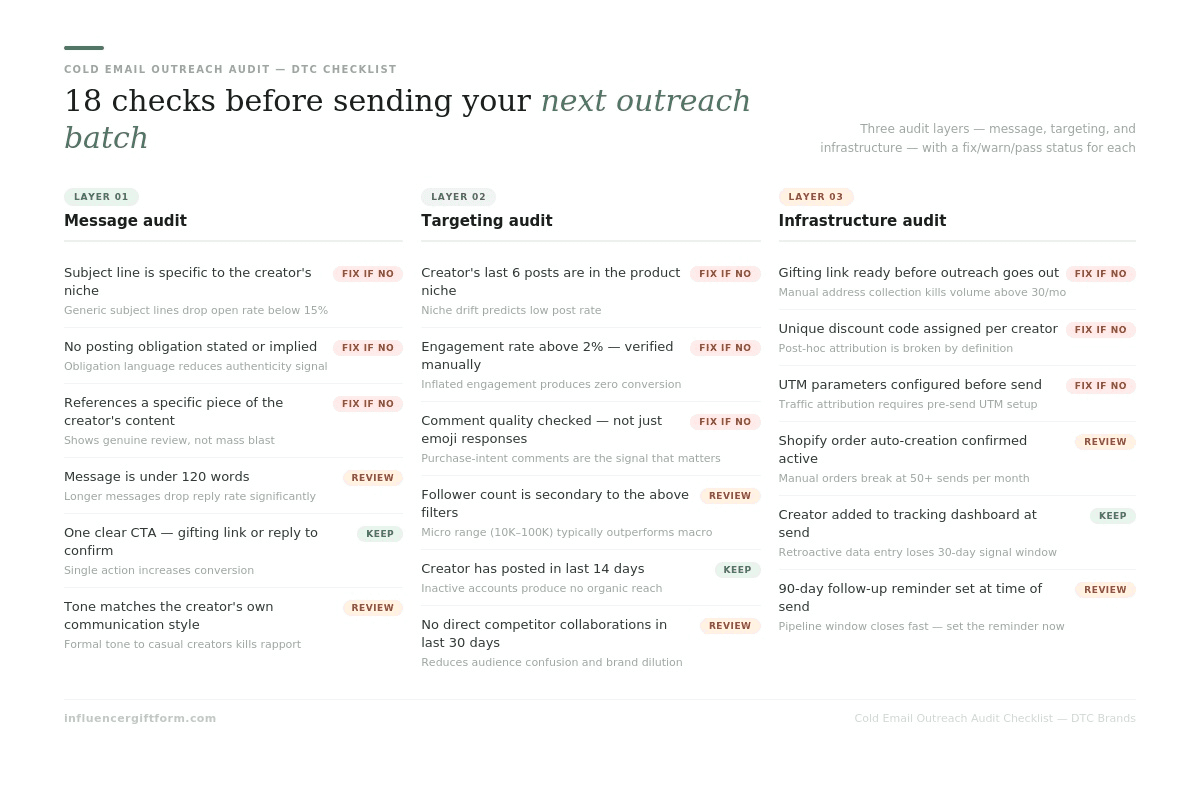
An influencer cold email outreach audit for DTC brands runs across three distinct layers: the message itself, the creator targeting, and the operational infrastructure behind the send. A problem in any one layer can collapse the results of a batch that gets the other two right.
According to Mailchimp's email benchmarks, cold outreach to creators in the lifestyle and fashion categories averages an open rate of 19–21% when subject lines are generic.
Personalized subject lines that reference the creator's specific niche or recent content push open rates to 35–45% in the same categories. The message layer is where most programs leak the most value.
The audit below maps to the full influencer campaign strategy workflow - from how the creator list was built through to the infrastructure that fulfils the send after a creator accepts.
Layer 1: the message audit - six checks on what you are actually sending
The message layer is the most visible and the most frequently overlooked. Teams spend significant time building creator lists and assembling product packs, then write the outreach message in ten minutes and send the same template to every creator on the list.
The six message-layer checks, in order of impact:
Subject line specificity - reference the creator's niche, not a generic "collaboration opportunity." Niche-specific subject lines push open rates from 19% to 35–45% in most categories.
No obligation to post - any outreach that implies a posting requirement changes the nature of the relationship before it begins. Creators who post freely generate more authentic content and stronger engagement signal.
Reference to a specific piece of content - one mention of a recent post or series signals genuine review over mass blast. Creators respond to it differently, and reply rates reflect that.
Message length under 120 words - longer messages drop reply rate significantly across creator categories. The message should communicate interest, extend the offer, and stop.
Single clear CTA - click the gifting link or reply to confirm interest. Multiple actions in one message reduce conversion on all of them.
Tone matching the creator's style - formal language sent to casual creators signals copy-paste. A brief review of the creator's own captions before writing produces a better-performing message.
For a framework on how to qualify creators before reaching out, this guide on how to find micro-influencers covers the niche fit and engagement quality filters that should precede any outreach.
Layer 2: the targeting audit - six checks on who is receiving the message
A perfectly written message sent to a misaligned creator produces the same result as a poorly written one. The targeting layer is where post rate is actually determined - the message layer only determines whether the creator opens and replies.
Niche stability is the first check. A creator whose last six posts are in the product category is a fundamentally different send than one whose feed has drifted into adjacent or unrelated content.
Niche drift predicts low post rate because the creator's audience has calibrated to different content - a product post from an off-niche creator lands as a departure, not a recommendation.
Engagement rate verification comes next, and it requires manual review rather than a tool output. An engagement rate above 2% is the minimum threshold for gifting consideration - but the number alone is not sufficient.
The micro-influencer scoring system that produces the most reliable post rate predictions weights comment quality above raw engagement rate. A creator with 4% driven by emoji reactions is a weaker send than one with 2.5% driven by questions and saves.
The remaining targeting checks that most teams skip:
Posting recency - a creator who has not posted in 14 days is a lower-priority send regardless of niche fit
No direct competitor collabs in the last 30 days - reduces audience confusion and brand dilution risk
Follower count in the 10K–100K range - micro-influencers outperform macro on product-specific post rate; treat count as a tiebreaker, not a primary filter
Layer 3: the infrastructure audit - six checks before the first message goes out
The infrastructure layer is the one most brands skip entirely - because the problems it produces do not appear until weeks after the send, when attribution is already broken and the data is unrecoverable.
Gifting link readiness is the most operationally critical check. If a creator responds with interest and the team has to collect their address via DM, the fulfilment bottleneck that the audit is designed to prevent immediately reasserts itself.
The gifting link needs to be built and tested before outreach begins, not assembled after a creator replies.
Influencer Gift Form handles this at the infrastructure level. A branded gifting link is ready for each send batch - the creator submits their preferences and address through the form, and a $0 Shopify order is created automatically.
No manual entry, no DM thread, no gap between creator acceptance and order creation.
The remaining infrastructure checks - all of which need to be in place before the first message goes out:
Unique discount code assigned per creator - a code added after a post cannot attribute the conversions that post already generated
UTM parameters configured before send - traffic attribution requires pre-send UTM setup; there is no retroactive fix
Shopify order auto-creation confirmed active - manual orders break at 50+ sends per month
90-day follow-up reminder set at time of send - the affiliate and ambassador conversion window closes faster than most teams act; set the reminder at send time, not when someone remembers
Running the audit as a pre-send protocol
The 18 point checklist produces the most value when it runs before every new send batch, not as a one time diagnostic.
Creator preferences change. Niche focus shifts. Infrastructure configurations break. An audit that only runs once captures the state of the program at a single moment in time. A recurring audit process catches problems before they create unrecoverable data gaps or operational failures.
For teams scaling beyond 50 sends per month, the infrastructure layer becomes the primary focus of the audit.
Tracking systems need to remain accurate as send volume increases.
Warehouse and Shopify workflows need to operate without manual intervention.
Attribution data needs to stay connected across creators, orders, and downstream conversions.
Broken automations or missing tracking parameters need to be identified before the next batch is shipped.
By this stage, the messaging and targeting layers are usually far more stable. Once a working outreach structure and reliable creator selection criteria are established, the operational system becomes the limiting factor, not the strategy itself.
The infrastructure layer is where volume creates new failure modes - and where workflow automation tools replace the manual processes that generate audit failures in the first place.
For a full operational template covering what to track after the outreach batch goes out, this influencer outreach dashboard template for Shopify brands maps the six tracking modules that convert outreach activity into auditable program data.
For brands formalizing creator relationships after the gifting stage, this guide on influencer agreement contracts covers the terms that protect both sides.
And for brands tracking repurposed UGC performance in paid campaigns, this guide on what is a good CPM provides current benchmarks.