Micro-influencer scoring system for DTC brand outreach
Build a micro influencer scoring system that predicts post rate, engagement quality, and affiliate potential using niche fit, creator consistency, audience signals, and collaboration history.

A micro-influencer scoring system turns a subjective judgment - "does this creator seem like a good fit?" - into a repeatable process that produces consistent creator lists, predictable post rates, and a feedback loop that gets sharper with every send cycle.
Without a scoring system, creator qualification depends on whoever is building the list that week. With one, the criteria are explicit, the thresholds are documented, and the output is comparable across batches.
That comparability is what makes it possible to learn from the data.
What a micro-influencer scoring system needs to measure
A micro-influencer scoring system for DTC brand outreach needs to score the signals that actually predict post rate and engagement quality - not the signals that are easiest to measure. The most common mistake is weighting follower count heavily because it is immediately visible.
It is also the least predictive variable a creator qualification framework can use.
According to CreatorIQ's 2023 creator economy report, micro-influencers (10K–100K followers) generate 60% higher engagement rates than macro-influencers for product-specific content.
The predictive variables behind that gap are niche fit and engagement quality - the two signals that a follower count cannot proxy for.
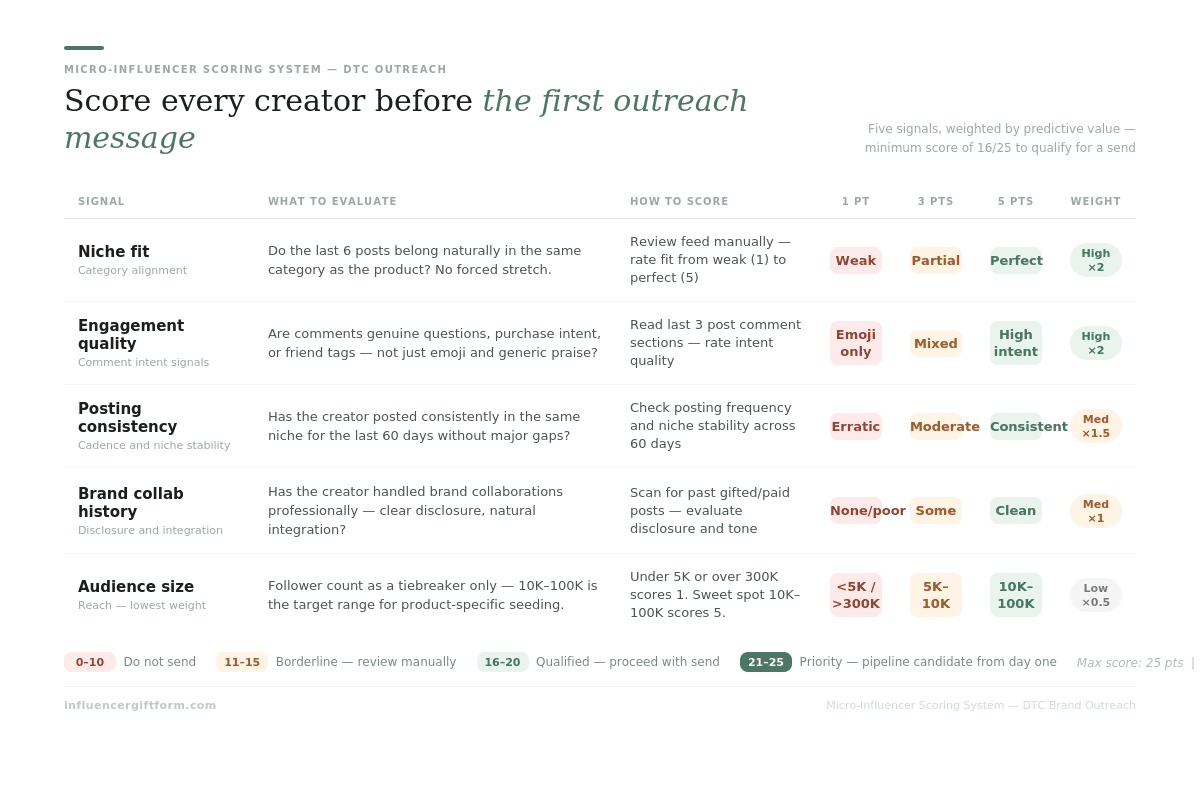
The five-signal framework assigns a score of 1, 3, or 5 to each signal, with weights that reflect predictive value. The scoring thresholds work as follows:
0–10 points - do not send; creator-product fit is too weak to generate reliable post rate data
11–15 points - borderline; review manually before adding to the send list
16–20 points - qualified; proceed with the gifting send
21–25 points - priority pipeline candidate; approach for affiliate or ambassador program within 90 days of first organic post
Signal 1: niche fit - the highest-weight variable
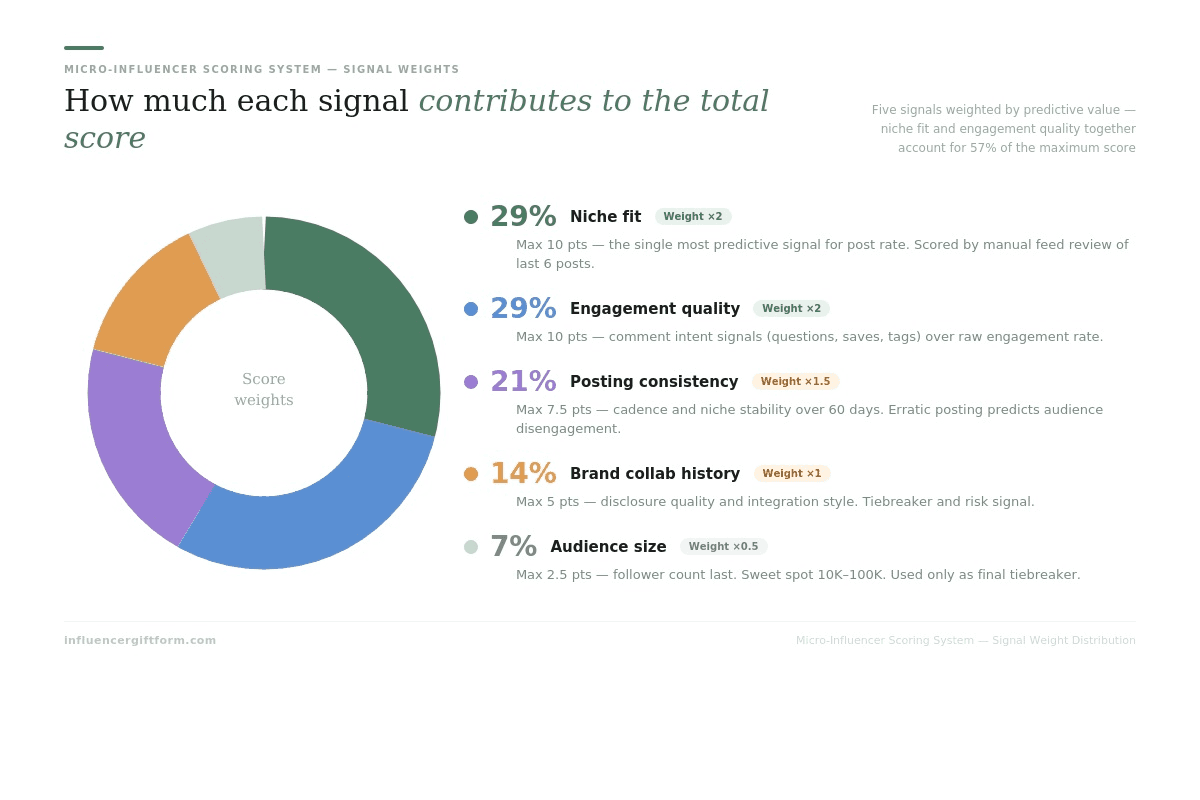
Niche fit is the highest-weight signal in the scoring system, and the one that most creator databases cannot assess automatically.
The question is not whether the creator is broadly in the right vertical - it is whether the product belongs naturally in their existing content without requiring the audience to recalibrate.
A creator whose last six posts are all skincare content, using products in the same price range and skin type as the gifted product, scores a 5. A creator who posts skincare occasionally among travel, food, and lifestyle content scores a 1.
The practical review takes about two minutes per creator: open the feed, look at the last six posts, assess whether the gifted product would appear as a natural addition or a departure.
Niche fit carries a 2x weight multiplier in the scoring system - a creator who scores 5 on niche fit and 1 on everything else qualifies at a higher threshold than one who scores 3 across the board.
For the sourcing process that produces niche-fit creator lists, this guide on how to find micro-influencers covers the hashtag research, tagged-post review, and community sourcing methods that outperform database searches for product-specific seeding.
Signal 2: engagement quality - comments over likes
Engagement quality is the second highest-weight signal, and it requires manual review rather than a tool-reported engagement rate.
The engagement rate number - total engagements divided by followers - conflates likes, comments, saves, and shares into a single figure that obscures the signal worth tracking.
The comment section is where purchase intent lives. The engagement patterns that score a 5 are distinct from those that score a 1, and the difference is visible in a two-minute review:
Score 5 - questions about where to buy, friend tags with recommendations, and saves that indicate intent to return
Score 3 - a mix of genuine engagement and filler comments; some real interaction, some generic responses
Score 1 - comment sections dominated by emoji responses, bot-pattern replies, and "great content!" filler with no product-relevant signal
A creator with a 3% engagement rate driven by score-5 patterns is a higher-quality send than one with 7% driven by score-1 patterns.
The full post rate prediction methodology this scoring system draws from is covered in this overview of influencer marketing best practices.
Signal 3 and 4: posting consistency and brand collaboration history
Posting consistency is the third signal - weighted at 1.5x. A creator posting four or more times per week in the same niche over the last 60 days scores a 5.
Moderate cadence with some gaps scores a 3. Erratic posting or a visible niche shift in the last 60 days scores a 1.
The reason this signal matters: a creator who posts inconsistently has an audience with a weaker ongoing relationship to their content.
A gifted product post from an inconsistently active creator lands differently than one from a creator whose audience checks in daily. Consistency predicts whether the gifted post reaches an active audience, not just whether it reaches any audience.
Brand collaboration history is weighted at 1x - useful as a tiebreaker and a risk signal, but not predictive of post rate on its own.
A creator who has handled previous brand collaborations with clear disclosure language and natural product integration scores a 5.
One with no collaboration history scores a 3, not a 1 - no history is not a negative signal for gifting, only for paid placements where professional execution matters more.
Signal 5: audience size - the tiebreaker, not the filter
Follower count is the last signal and the lowest-weight one, at 0.5x. The target range for product seeding programs is 10K–100K followers - this range scores a 5.
Creators between 5K and 10K score a 3. Under 5K or over 300K both score a 1, for different reasons: under 5K produces insufficient reach for meaningful engagement data; over 300K typically produces lower niche fit and engagement quality scores that make the gifting investment harder to justify.
The scoring system weights follower count last deliberately. A creator with 12K followers who scores 5 on niche fit, 5 on engagement quality, 5 on posting consistency, 3 on brand collaboration history, and 5 on audience size scores 23/25 - a priority pipeline candidate.
A creator with 85K followers who scores 1 on niche fit and 1 on engagement quality scores 7/25 regardless of their reach. That is the correct outcome.
Using the score to build a feedback loop
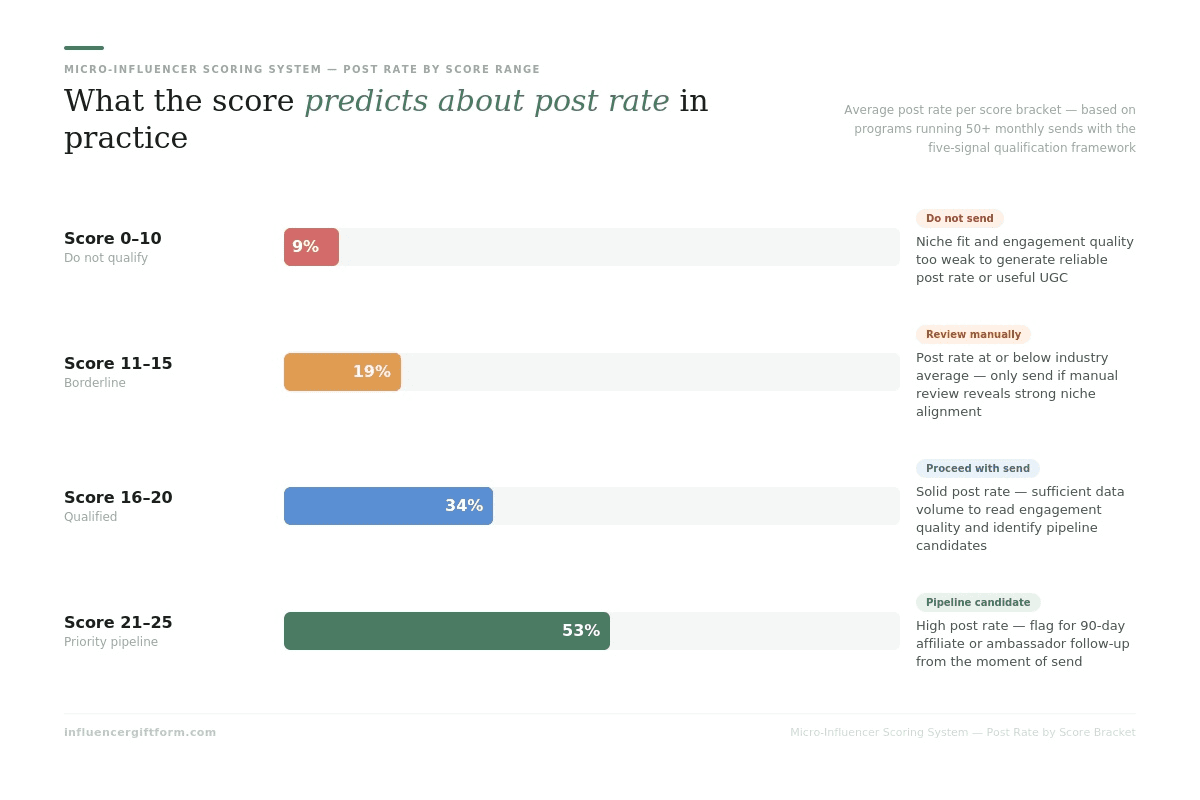
The scoring system produces its most valuable output over time, not on the first use. After three or four send cycles, the data reveals which score thresholds actually predict post rate and engagement quality in the brand's specific category - and the thresholds can be refined accordingly.
Two refinements that most programs make after the first few cycles:
Raising the qualification threshold if creators scoring 16–17 post at significantly lower rates than those scoring 18+, the minimum should move up
Increasing the niche fit weight if creators scoring 5 on niche fit consistently post at 50%+ regardless of other signals, weighting it at 3x rather than 2x produces a tighter, higher-performing list
This feedback loop is only possible if the scoring data and the post-send data are stored together.
The influencer outreach dashboard template that supports this system records both the pre-send score and the post-send outcomes for each creator - making the calibration visible after every program cycle.
For brands using Influencer Gift Form to manage fulfilment, every send is logged against the Shopify order history, giving each creator record a complete trail from qualification score through to attributed revenue per send.
For context on the broader acquisition picture that creator pipeline revenue feeds into, this overview of ecommerce growth strategies for Shopify brands maps the creator channel against other levers. For brands scaling past 50 sends per month, this Shopify gifting case study shows the full operational model in practice.