How high-growth DTC brands run product seeding programs
Learn how high growth DTC brands scale product seeding through creator scoring, automated gifting, UGC repurposing, pipeline conversion, and structured ROI tracking across every send cycle.

High-growth DTC brands run product seeding programs differently from the average - and the gap in outcomes reflects that.
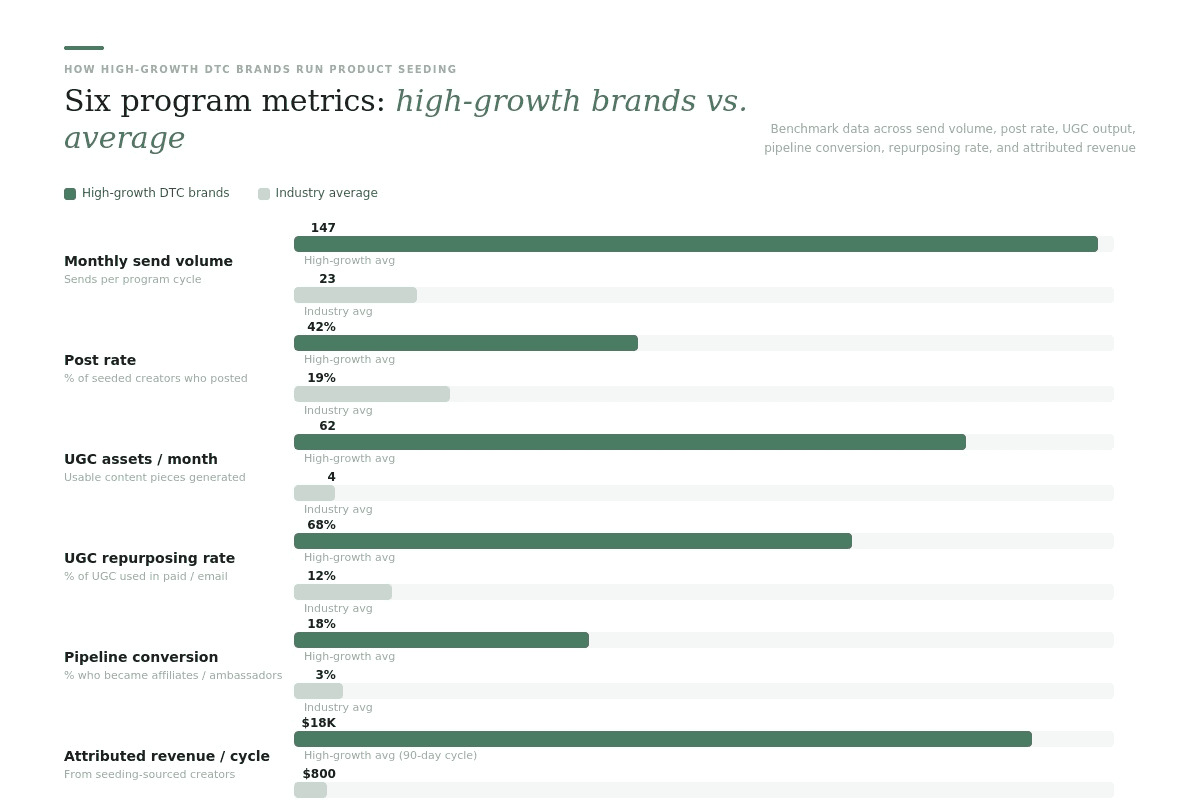
An industry-average gifting program sends to 23 creators per month, generates a 19% post rate, and produces 4 usable UGC assets per cycle.
A high-growth program running on the same category of products sends to 147 creators per month, generates a 42% post rate, and produces 62 usable assets.
The difference is not product quality or creator relationships. It is program structure.
The practices below are drawn from what consistently separates programs that compound from programs that plateau.
Each one is operational, not aspirational - the kind of decision that shows up in a dashboard configuration or a send workflow, not in a brand positioning document.
How high-growth DTC brands run product seeding programs differently
High-growth DTC brands run product seeding programs with a single structural principle that most average programs lack: every send is designed to feed the next one.
Creator qualification data from one cycle refines the list for the next. Engagement quality data identifies pipeline candidates before the follow-up window closes. UGC from organic posts enters a repurposing pipeline within days, not months.
According to Influencer Marketing Hub's 2024 benchmark report, high-growth brands in the DTC category report pipeline conversion rates of 18% from gifting programs - meaning 18 out of every 100 seeded creators who post organically move into an affiliate or ambassador program within 90 days.
The industry average is 3%. The gap is almost entirely explained by whether brands have a systematic 90-day follow-up process in place, not by whether their products are better.
They send at volume - and have the infrastructure to support it
The single most reliable predictor of program performance is send volume. At 23 sends per month - the industry average - a program does not generate enough data in a 90-day cycle to make reliable decisions about creator selection, engagement quality thresholds, or pipeline conversion timing.
At 147 sends, those decisions are well-supported by data within every cycle.
High-growth brands are not sending more because they have bigger budgets. They are sending more because they removed the operational constraints that limit most programs to 20–30 monthly sends.
The manual gifting workflow - DM outreach, address collection, Shopify order entry, spreadsheet tracking - breaks at 50 sends per month.
Teams that have not replaced it with automated infrastructure hit that ceiling and stop.
Influencer Gift Form is the infrastructure layer that makes high-volume seeding operational. A secure gifting link replaces the DM chain.
A $0 Shopify order is created automatically from every creator form submission. Per-creator tracking connects every send to Shopify order history.
The result is a program that scales from 20 to 200+ monthly sends without adding coordinator headcount - which is exactly what the benchmark data shows high-growth brands achieving.
They qualify creators on fit, not on follower count
High-growth programs build creator lists by applying three filters in sequence: niche fit, engagement quality, and posting consistency.
Follower count is assessed last and used only as a tiebreaker.
This ordering produces post rates of 42% versus the industry average of 19% - because post rate is driven by fit, not by reach.
A creator with 18K followers whose entire feed is built around the product category will post at a higher rate than one with 180K followers who occasionally drifts into it.
High-growth brands have learned this from program data; average programs keep rebuilding lists by sorting on follower count because it is the fastest filter to apply.
The micro-influencer scoring system that high-growth programs use assigns numerical scores to each of the five qualification signals - which makes the list-building process repeatable by anyone on the team.
For the sourcing process that produces those lists, this guide on how to find micro-influencers covers the methods that outperform database searches for product-specific seeding.
They repurpose UGC systematically - not occasionally
Average programs capture 4 UGC assets per month and use 12% of them in paid or email creative.
High-growth programs capture 62 assets per month and repurpose 68% of them - a gap that reflects a systematic process rather than a volume advantage alone.
The repurposing protocol that high-growth programs run on is consistent across categories:
Log every organic post within 24 hours of discovery - tagged by creator, platform, format, product, and posting date
Review the UGC library weekly - top-performing posts identified by engagement quality, not likes, are submitted to the paid creative team
Test seeded UGC against the studio creative baseline - track click-through rate per asset to identify which content types produce the lowest cost per acquisition
Shoppable UGC repurposed from seeding campaigns consistently outperforms studio-produced creative in paid placements.
According to Stackla's consumer content report, authenticity of origin travels with content into paid placements - audiences process creator content differently than brand-produced content even when it is served as a paid ad.
The brands that capture and deploy UGC at high volume have a structural creative cost advantage that compounds with each program cycle.
They act on pipeline candidates within 90 days
The 18% pipeline conversion rate that high-growth brands achieve is not a function of better creator relationships. It is a function of timing.
Creator interest peaks in the 30 days following an organic post - the product experience is fresh, the brand relationship is active, and the engagement data from the post is visible to both sides.
Average brands approach the same creators three to six months later, when the product experience has faded and the data is no longer a natural conversation entry point.
The conversion rate in that window is significantly lower - which is why the industry average sits at 3%.
High-growth programs set a 90-day follow-up reminder at the time of each send, review the engagement data at day 60, and contact qualifying creators with a structured offer within the active window.
The offer types that produce the highest acceptance rates are:
An affiliate program with a unique discount code and commission on attributed sales
An ambassador agreement with a fixed monthly retainer and content deliverables
A paid content arrangement for creators with strong enough signal to justify a one-time fee
The influencer agreement contracts that formalize these relationships are simpler than most brands expect - which is why the follow-up timing matters more than the terms.
They measure all six signal layers - not just post rate
The final structural difference is measurement depth. Average programs measure post rate at 30 days and call the cycle complete.
High-growth programs measure six signals across a 90-day window: post rate and UGC volume at day 30, engagement quality and repurposing performance at day 60, pipeline conversion rate and attributed revenue at day 90.
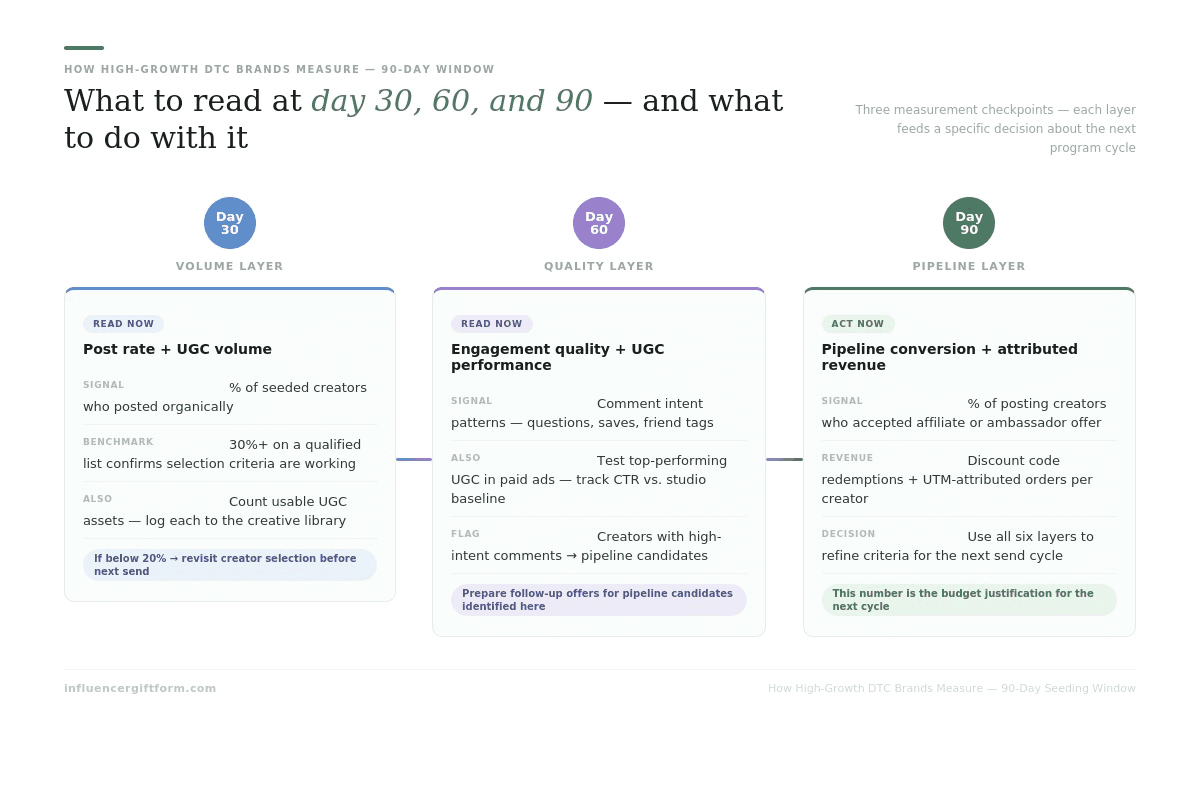
Each layer feeds decisions about the next program cycle. The decisions each signal layer drives are specific:
Post rate → refines creator selection criteria and qualification thresholds
UGC volume → determines send volume needed for the next creative repurposing cycle
Engagement quality → identifies which creators to approach for pipeline conversion
Repurposing performance → reveals which product categories generate the highest-value paid creative assets
Pipeline conversion rate → validates whether the follow-up timing and offer structure are working
Attributed revenue → produces the budget justification for the next program cycle
For a detailed breakdown of how each of the six metrics connects to downstream ROI, this guide on ROI in product seeding covers the full measurement framework.
For brands building their first structured program, this overview of ecommerce growth strategies for Shopify puts the creator channel in the context of the broader acquisition mix.