Influencer marketing best practices for DTC brands running gifting programs
Learn the influencer marketing best practices that improve post rate, UGC quality, creator relationships, attribution tracking, and long term ROI for DTC product seeding programs.
Influencer marketing best practices are not a checklist of good intentions - they are the specific decisions that determine whether a gifting program generates post rate, usable UGC, and creator pipeline.
Or whether it just ships product into silence and produces a spreadsheet nobody reads.
Most of the mistakes happen early and quietly. A creator list built on follower count. Outreach that implies obligation.
Addresses collected via DM chains that collapse at volume. By the time the team reads the post rate data, the structural problems are already baked in.
The practices below address each of those decision points in the order they occur.
What influencer marketing best practices actually govern
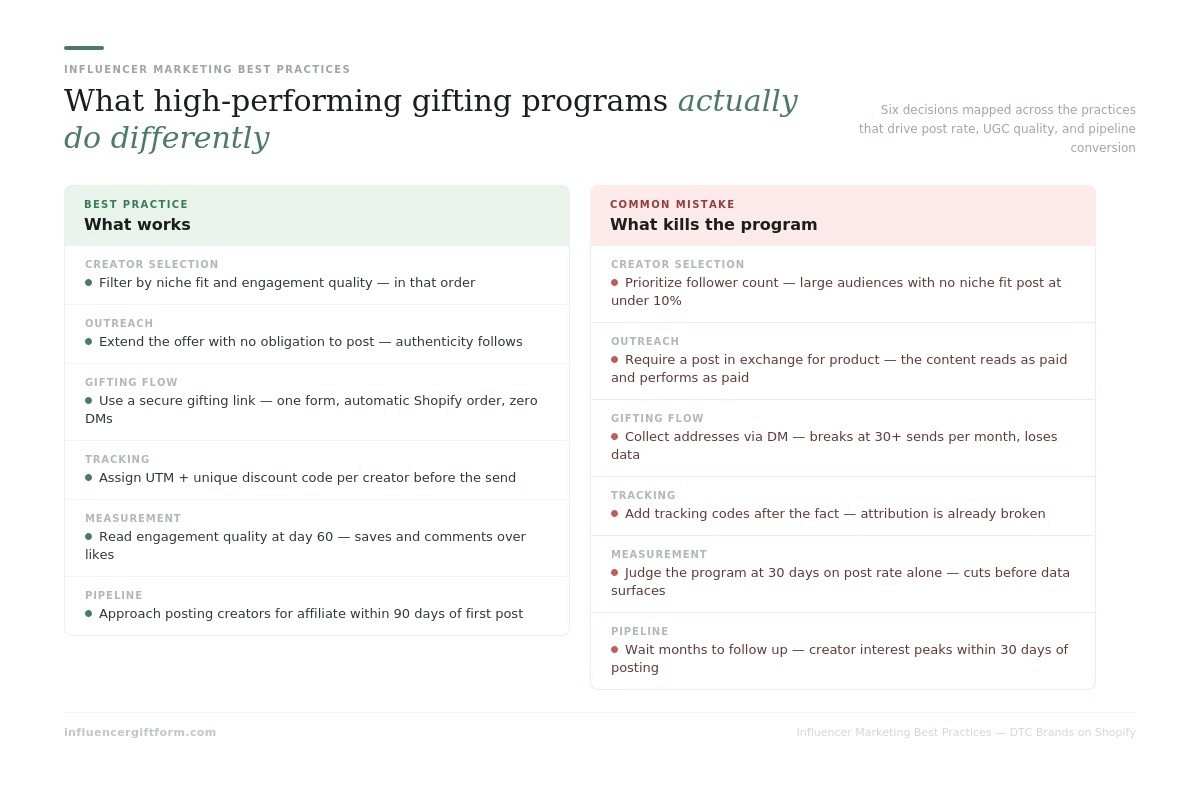
Influencer marketing best practices cover six decisions: who gets selected, how they are approached, how the gifting is fulfilled, how each send is tracked, when and how performance is measured, and what happens with posting creators after the first organic post.
Each decision has a direct effect on the ones that follow. A creator list built without niche fit produces low post rate. Low post rate produces thin engagement data. Thin engagement data makes pipeline conversion impossible.
According to Influencer Marketing Hub's 2024 benchmark report, brands with documented influencer program frameworks generate 11x more ROI than those running ad-hoc campaigns - and the gap is almost entirely explained by the quality of those early decisions, not by budget.
The product seeding programs that produce consistent returns are structured around the same six decisions.
Getting them right does not require a large team or a high spend - it requires applying the right criteria in the right sequence.
Creator selection: filter by fit before anything else
The single decision that most reliably predicts program performance is also the one most often made on the wrong basis.
Follower count is the least predictive filter available for a gifting program - yet it is the first thing most brands sort by when building a creator list.
A creator with 400K followers in a broad lifestyle niche will generate less authentic content about a specialty skincare product than one with 18K followers whose entire feed is built around skincare routines.
The larger creator has reach. The smaller one has fit. In a seeding context, fit predicts post rate and engagement quality; reach predicts neither.
The filter sequence that produces the strongest post rates applies criteria in this order: niche fit first, engagement quality second, posting consistency third.
Micro-influencers in the 10K–100K range typically score higher on all three criteria than macro-influencers for product-specific gifting - which is why most high-performing programs are built around them.
According to CreatorIQ's 2023 creator economy report, micro-influencers generate 60% higher engagement rates than macro-influencers for product-specific content.
For a more detailed breakdown of how these criteria map to actual program outcomes, this guide on influencer selection covers the full qualification framework.
Outreach: no obligation to post is not a courtesy - it is a strategy
The outreach message determines the quality of content a program generates, not just the acceptance rate.
Creators who receive gifted product without posting obligation are more likely to post organically - and when they do, the content reads as a genuine recommendation rather than a fulfilled transaction.
Requiring a post in exchange for product produces content, but it produces a specific kind: content that the creator's audience processes as advertising, because it is advertising.
The engagement on that content reflects that - comment sentiment is different, save rates are lower, and the conversion signal that makes a posting creator worth formalizing is absent.
The practical implication is that outreach should communicate genuine interest in the creator's work, extend the gift clearly, and say nothing about posting expectations.
Creators who receive product from a brand they respect and then choose to share it are the ones whose audiences respond with purchase intent.
Those are also the ones to approach for ambassador programs once the organic engagement data is readable.
Gifting flow: the manual process has a volume ceiling and it is lower than you think
The standard gifting workflow - DM the creator, wait for a response, ask for address and size preferences, wait again, manually enter a Shopify order, track it in a spreadsheet - is functional at around 20 sends per month.
At 50, it consumes enough coordinator time to become the primary constraint on program growth. At 100, it breaks.
The problem is not just efficiency. It is that a program running 20 sends per month does not generate enough data volume to produce statistically reliable signals on post rate, engagement quality, or pipeline conversion.
The operational bottleneck and the data problem are the same problem.
Influencer Gift Form replaces the manual chain with a single secure gifting link sent to each creator.
The creator opens a branded form, selects product preferences, submits their shipping address, and a $0 Shopify order is created automatically - no manual entry, no DM thread, no spreadsheet row. Every send is tracked in a dashboard linked to Shopify order history, which makes post-send attribution possible without additional tooling.
For brands deciding which products to include in each send, this breakdown of gifts for influencers by category maps product types to post rate and cost at scale.
Tracking: attribution needs to be in place before the product ships
The most common attribution mistake in influencer gifting programs is adding tracking after the fact - assigning UTM parameters or discount codes to creators who have already received product and may have already posted.
At that point, any conversion data the post generates is either unattributable or attributed incorrectly.
UTM parameters and unique discount codes need to be assigned to each creator at the time of gifting confirmation - before the order ships.
This is the only way to connect organic post performance to downstream conversion data in a way that holds up when someone asks for program ROI numbers.
The tracking setup does not need to be complex. A unique discount code per creator, applied at checkout, captures direct conversion signal.
A UTM link in any post description or bio captures traffic signal. Together, they turn the six metric layers described in this guide on ROI in product seeding into auditable numbers rather than estimates.
Measurement: post rate at day 30 is one data point from a chain of six
Cutting a gifting program after one send cycle because the post rate was lower than expected is one of the most reliable ways to waste the product cost and learn nothing.
Post rate at 30 days is the least informative signal the program will eventually generate - but it is the one most teams use to make the keep-or-cut decision.
A seeding program produces six signals across three layers: post rate and UGC volume in the first 30 days; engagement quality and shoppable UGC repurposing performance by day 60; pipeline conversion rate and downstream attributed revenue by day 90.
Reading the program at any point before day 60 captures the least valuable layer of data.
The 90-day measurement window is also when the repurposed content advantage becomes visible.
Seeded UGC repurposed as paid ad creative consistently outperforms studio-produced assets - tracking click-through rate against a studio baseline reveals a cost-per-acquisition advantage that post rate alone never captures.
For CPM benchmarks on that repurposed content, this guide on what is a good CPM provides current reference points.
Pipeline conversion: the 90-day follow-up window closes faster than most brands act
The organic post is the start of the relationship, not the end of the transaction.
Creators who posted, generated genuine engagement, and whose audiences responded with purchase-intent signals are the candidates for formalization - affiliate agreements, ambassador programs, or paid content arrangements.
The follow-up timing matters more than most brands realize. Creator interest peaks in the 30 days following the organic post, when the product experience is fresh and the brand relationship is active.
Approaching the same creator six months later produces a different conversation - and a significantly lower acceptance rate.
A program that converts 15% of posting creators into affiliates, each generating $2,000 in attributed revenue per quarter, produces a return that makes the gifting spend straightforward to justify.
For brands managing that formalization at scale, this overview of influencer agreement contracts for gifting programs covers the structure that protects both sides.
How Influencer Gift Form operationalizes all six best practices at once
Each of the six practices above has an operational requirement. Creator qualification requires a review process.
Outreach without obligation requires a clear message template. Fulfillment at volume requires infrastructure that removes the manual ceiling.
Tracking requires per-creator code assignment before shipment. Measurement at 90 days requires a dashboard that retains data across the full window.
Pipeline conversion requires a process for identifying and approaching posting creators before the window closes.
Running all six manually is possible at small scale. At 50 to 200 sends per month - the volume where seeding data becomes statistically meaningful - it requires tooling that handles the operational layer without consuming the team.
Influencer Gift Form was built for that specific scale. The secure gifting link, automatic Shopify order creation, and per-creator tracking dashboard address the fulfillment, attribution, and measurement requirements in a single workflow.
For brands evaluating how it compares to broader platforms, this breakdown of GRIN alternatives covers the tradeoffs directly.
And this Shopify gifting case study shows what the operational model looks like at scale for a real DTC brand.