ROI in product seeding: the metrics that actually matter for DTC brands
Learn which metrics actually measure ROI in product seeding, from post rate and UGC performance to affiliate revenue, pipeline conversion, and long term creator relationships.

ROI in product seeding is one of the most misunderstood measurements in influencer marketing - not because the math is difficult, but because most brands measure the wrong things.
A program gets judged by post rate after the first send, falls short of an arbitrary benchmark, and gets cut before it has had enough time or enough data to produce real returns.
The brands running seeding as a permanent acquisition channel measure it differently. They track six signals across three layers of the funnel - from organic content volume all the way through to downstream pipeline revenue - and they treat each layer as a leading indicator of the next.
That approach changes everything from budget allocation to the decision of whether to scale or pause.
What ROI in product seeding really measures: why post rate alone is not enough
ROI in product seeding is the return generated across all downstream outputs of a gifting program, not just the immediate content it produces. A brand that measures only post rate is seeing one data point from a chain of six.
Post rate matters. A benchmark of 30% or higher on a well-qualified creator list is a reasonable signal that selection criteria are working. Anything significantly below that points to a creator-product fit problem, not a product problem.
But post rate measures activity - not value. The value of a seeding program accumulates in layers that take weeks and months to surface.
According to Aspire's influencer marketing data, product seeding accounted for 31% of all influencer campaigns tracked on their platform in recent years - up from 20% the year prior.
That growth reflects a structural recognition among DTC brands that the return on seeding compounds in ways that single-campaign paid placements simply cannot replicate.
The influencer gifting programs that produce the strongest long-term ROI share a common measurement framework.
They track volume signals, quality signals, and pipeline signals in parallel - and they use each layer to inform decisions about the next one.
The six metrics worth tracking - and what each one actually predicts
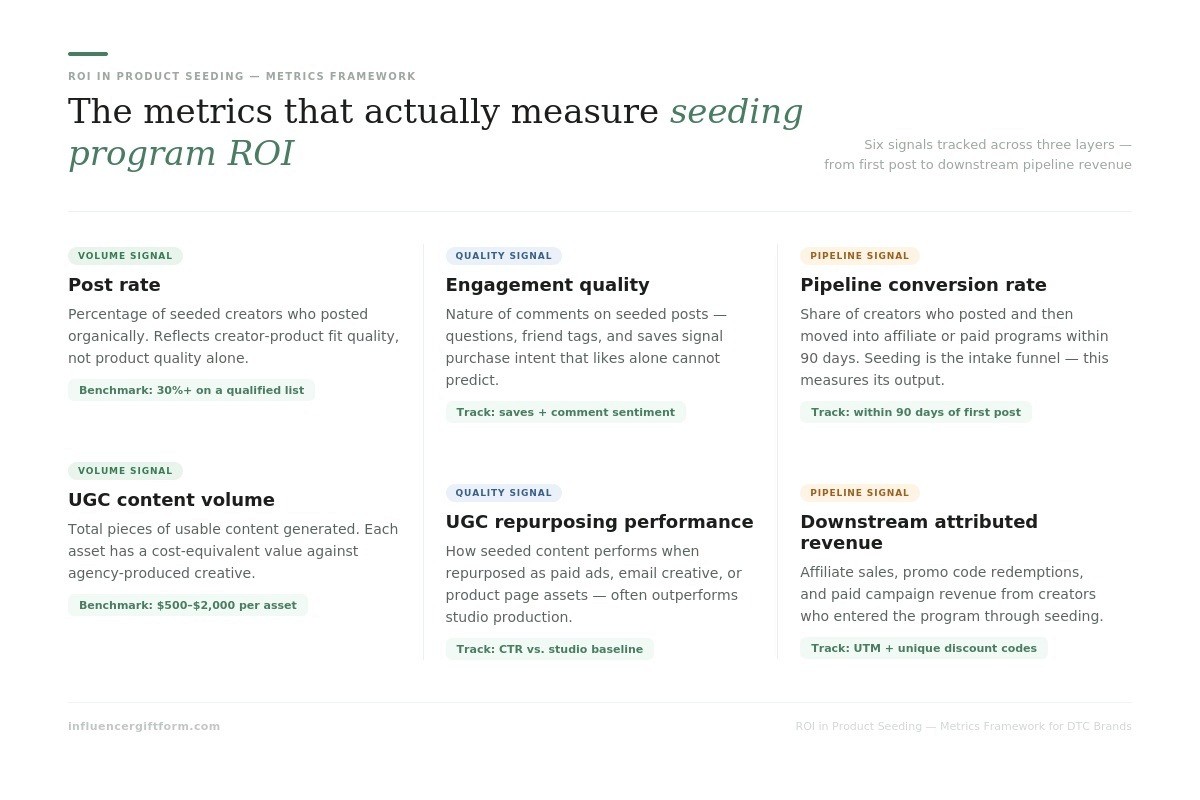
A well-run seeding program generates six distinct signals that together produce a complete picture of ROI. Each one belongs to one of three layers: volume, quality, and pipeline.
Post rate is the entry-level volume signal. It measures the percentage of seeded creators who posted organically after receiving product.
A baseline of 30% is reasonable for a targeted program; below 20% is a clear signal to revisit creator selection criteria before increasing send volume.
UGC content volume is the second volume signal - and the one most brands undercount.
Each piece of usable content generated through seeding has a cost-equivalent value against agency-produced creative, typically ranging from $500 to $2,000 per asset depending on format and platform.
A seeding program that generates 40 pieces of usable content at a $60-per-send cost has produced more creative value than many brands realize when they call the program "low ROI."
Engagement quality is the first quality signal, and it requires going past the engagement rate number.
The relevant data lives in the comments - questions about where to buy, tags of friends, and saves are all intent signals that likes cannot replicate.
A post with a 2% engagement rate driven by purchase-intent comments is more valuable than one with 6% driven by emoji reactions.
UGC repurposing performance is the second quality signal and the one with the most direct revenue connection.
When shoppable UGC from seeding campaigns gets repurposed as paid ad creative, it consistently outperforms studio-produced assets - because the authenticity of origin travels with the content even when it is boosted.
Tracking click-through rate against a studio baseline reveals the true cost-per-conversion advantage of seeding.
Pipeline conversion rate is the first pipeline signal: the share of posting creators who moved into an affiliate or paid program within 90 days.
This is the metric that measures whether seeding is feeding something larger - which is the only way it produces compound returns.
Organic engagement signal is the most reliable filter available for identifying which creator relationships are worth formalizing.
Downstream attributed revenue closes the loop. Affiliate sales, promo code redemptions, and paid campaign revenue from creators who entered the program through seeding - tracked via UTM parameters and unique discount codes - convert every upstream metric into a dollar figure.
This is where the true ROI in product seeding becomes auditable.
How seeding ROI compounds - what the numbers look like at six months
The brands that call seeding "low ROI" are almost always measuring at the wrong time horizon.
A seeding program does not produce its full return in the first send. It produces it across a 6-to-12-month arc that looks like this:
In the first 30 days, the measurable output is content volume and post rate. Both are useful, but neither reflects the downstream value the program will generate.
By month three, the quality signals become readable - engagement patterns across seeded posts reveal which creators have audiences that respond to the brand.
The pipeline conversion rate also starts to surface as early organic posters are approached for affiliate and ambassador programs.
By month six, the downstream attributed revenue signal becomes statistically meaningful.
Brands running consistent seeding programs at 50 to 200 sends per month - without proportional headcount increases - report that creator relationships built through seeding generate a disproportionate share of their affiliate and paid campaign revenue.
This happens precisely because those relationships were built on genuine product affinity rather than a contract.
The compounding dynamic is what separates seeding from a one-off PR send. It requires patience in the early months and systems thinking from the beginning - including the infrastructure to track each signal layer without losing data to manual processes.
The operational constraint that collapses ROI before the data can surface
The most common reason a seeding program produces poor ROI is not creator selection or product quality.
It is an operational bottleneck that prevents the program from scaling to the volume where the data becomes meaningful.
The standard manual workflow - DM outreach, address collection, manual Shopify order entry, spreadsheet tracking - is functional at 20 sends per month.
At 50, it consumes enough coordinator time to stall growth. At 100, it breaks. And a program running 20 sends per month simply does not generate enough data to produce statistically reliable signals across any of the six metric layers described above.
This is the specific friction that Influencer Gift Form was built to remove. The tool replaces the entire manual chain with a single secure gifting link sent to each creator - no DM back-and-forth, no manual order entry, no spreadsheet tracking.
A creator opens the form, selects product preferences, submits their address, and a $0 Shopify order is created automatically through the existing warehouse flow.
The workflow automation benefit is not just time saved. It is the removal of the volume ceiling that prevents ROI from compounding.
Brands that have made this transition consistently report programs scaling from 20 to 200+ monthly sends without adding headcount - because the constraint was operational, not strategic.
Building a seeding program that produces measurable ROI from the start
Measurement infrastructure needs to be in place before the first send, not retrofitted after a program has been running for three months without trackable data.
The minimum viable tracking setup for ROI in product seeding includes:
Unique UTM links or discount codes for each creator, applied at the time of gifting confirmation
A tagging system inside Shopify to flag orders that originated from seeding sends
A simple creator CRM - even a structured spreadsheet - that records send date, post date, engagement quality notes, and pipeline status for each creator
A creative library that captures all seeded UGC as it goes live, tagged by creator, format, and platform for repurposing
A 90-day pipeline review cadence to convert organic posters into affiliate candidates based on engagement signal
With this infrastructure in place, every metric layer described above becomes trackable within a single program cycle.
Without it, the only number a team can report is post rate - and post rate alone will never justify the budget a seeding program deserves.
For brands deciding which products to include in each send, this breakdown of gifts for influencers by category maps product types against posting rate and cost - a useful filter before building the first creator list.
How Influencer Gift Form turns seeding into a measurable acquisition channel
The infrastructure problem and the operational problem are related - and they are both solved by the same shift.
A program that runs on manual processes cannot scale to meaningful data volume, and a program without meaningful data cannot produce auditable ROI.
Influencer Gift Form addresses both constraints at once. Beyond removing the address-collection and order-entry bottleneck, the tool enables:
Tracking of every gifted creator in a single dashboard linked to Shopify order history
Automatic $0 order creation that preserves the full product and variant data for post-send attribution
Scalability from 20 to 200+ monthly sends without adding operational overhead
Integration with existing Shopify fulfillment, so seeding volume does not require a separate logistics track
A repeatable gifting flow that supports the consistent send cadence required to generate statistically meaningful ROI data within 90 days
For brands comparing tooling options before scaling, this overview of micro-influencer platforms covers how purpose-built seeding tools differ from all-in-one platforms on pure-ROI workflows.
The brands that have built seeding into a measurable acquisition channel are not operating with bigger budgets or longer creator lists.
They are operating with better infrastructure and a longer measurement window - and they are tracking all six signal layers, not just the one that shows up in the first two weeks.
For brands ready to run seeding at the volume where ROI becomes auditable, start a free trial of Influencer Gift Form and send your first qualified batch without a single manual order.