Influencer selection: how to pick the right creators for your seeding program
Learn how to choose influencers for product seeding using niche fit, engagement quality, and content consistency to improve posting rates, authenticity, conversions, and creator relationships.

Influencer selection is the decision that determines whether a seeding program generates real content and real relationships - or just ships product into silence.
Most DTC brands that struggle with low post rates and poor ROI from gifting campaigns share a common root cause: they treated creator selection as a volume problem when it is actually a fit problem.
Sending product to 500 misaligned creators produces worse results than sending to 50 who genuinely belong in the same category as the brand.
The criteria matter more than the list size, and getting them right from the start is what separates programs that compound from programs that stall.
What influencer selection actually predicts in a seeding program
Influencer selection is the process of identifying and qualifying creators whose audience, content style, and niche make them likely to engage authentically with a product - and, from that engagement, generate content that functions as a genuine recommendation rather than a paid placement.
The distinction between a recommendation and an ad is not subtle for the audience. It changes attention, trust, and purchase intent.
According to data from Aspire, product seeding accounted for 31% of all influencer campaigns in recent years - up from 20% the year prior - precisely because brands have recognized that obligation-free content carries a different quality of authenticity.
What selection predicts, specifically:
Whether the creator will post at all after receiving the product
Whether their audience will respond with genuine purchase intent, not just passive engagement
Whether the resulting UGC content can be repurposed effectively in paid ads and email
Whether the relationship has the potential to evolve into an ambassador or affiliate partnership
None of these outcomes are guaranteed regardless of how good the product is. But they become significantly more likely when the selection criteria are applied correctly from the start.
Why follower count is the wrong primary filter
The most common mistake in product seeding is using follower count as the primary qualification filter.
It feels like a logical proxy for reach - and reach feels like the point of seeding. The logic breaks down quickly when examined against actual program outcomes.
A creator with 400K followers in a broad lifestyle niche will generate less authentic content about a specialty skincare product than a creator with 18K followers whose entire feed is built around skincare routines.
The larger creator has reach. The smaller one has fit. In a seeding context, fit wins.
Micro-influencers in the 10K–100K range consistently outperform macro creators for seeding campaigns because their audiences are tighter and their recommendations land closer to personal advice than advertising.
The trust gap between organic and paid content is already wide; micro-influencer audiences experience it as even wider because they have fewer paid placements to calibrate against.
Follower count is a measure of past growth - not current influence over purchase behavior. Brands running micro-influencer platforms comparisons consistently find that engagement quality and niche alignment are the variables that move post rate and downstream conversion, not raw audience size.
The five criteria that actually matter for influencer selection
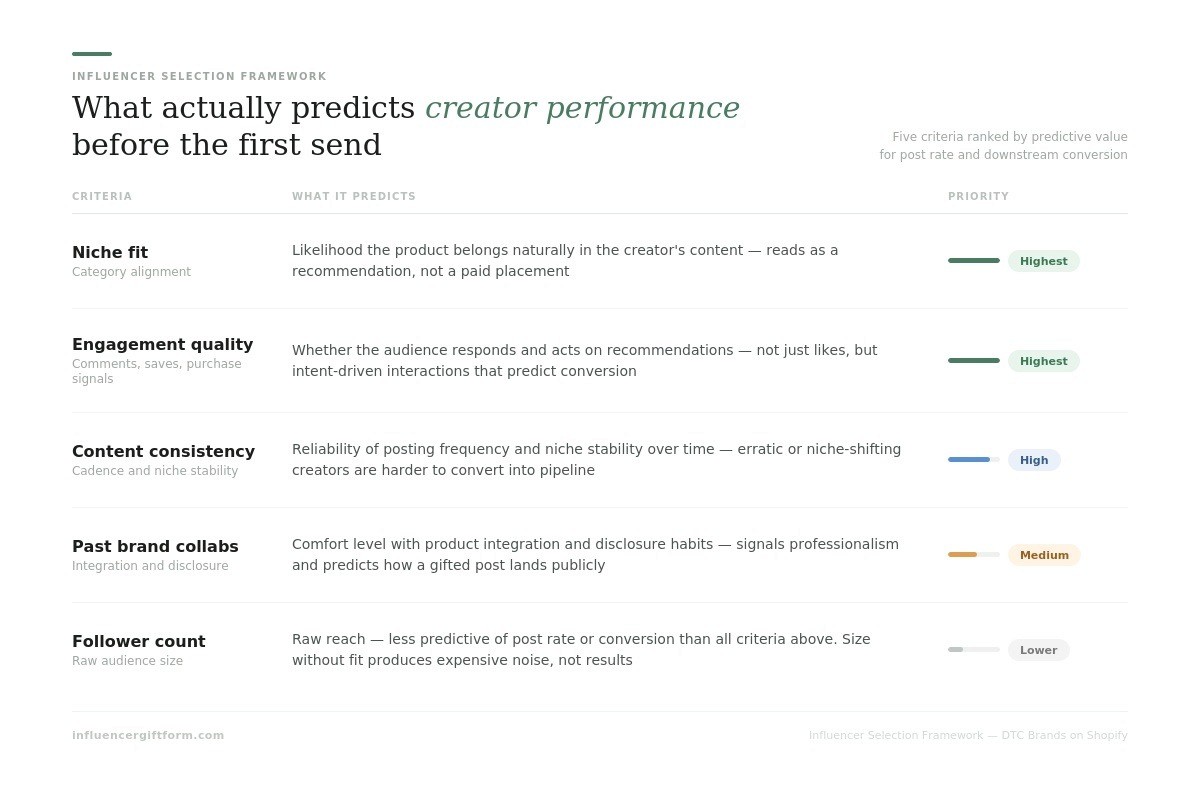
The selection framework that produces the strongest seeding outcomes prioritizes five criteria, in order of predictive value.
Niche fit is the highest-priority signal. It measures the likelihood that the product belongs naturally in the creator's content - that a viewer encountering it in their feed would not register it as out of place.
A beauty creator posting about a moisturizer has niche fit.
The same creator posting about a kitchen appliance does not. This single variable predicts post rate more reliably than any other.
Engagement quality is the second highest-priority signal, and it requires looking beyond the engagement rate number.
The relevant question is not "how many people liked this?" but "did anyone actually respond to this as if it mattered to them?" Comments that ask follow-up questions, tags of friends, and saves are all stronger signals of purchase intent than likes.
A creator with a 3% engagement rate driven by genuine comments is more valuable than one with a 6% rate driven by emoji replies.
Content consistency measures whether the creator posts regularly in the same niche over time.
Erratic posting cadence or frequent niche shifts signal that the audience relationship is weaker - and that a seeding send is more likely to fall into a content gap than land in front of an engaged audience.
Past brand collaborations indicate comfort with product integration and disclosure.
Creators who have handled gifted products professionally in the past - clear disclosures, natural integration, authentic language - are lower operational risk than those with no history of brand work.
Follower count a It is not irrelevant, but it is the output of the other four variables, not the driver of them.
A well-qualified list of 60 creators built on these criteria will produce more content, stronger relationships, and better pipeline candidates than a list of 300 built on follower count alone.
How to build a qualified creator list without expensive tools
The identification process does not require a paid platform at the early stage. The goal is to find creators who would use the product naturally - not ones who need to be convinced to care.
Reliable sources for initial list-building include:
Hashtag research on Instagram and TikTok for the product category and adjacent categories
Tagged posts on the brand's own account - existing customers who already use and share the product
Competitor tagged pages - creators who post about similar products in the same niche
Comment sections of posts in the category - creators who engage actively often have tighter communities than those who post passively
Once a shortlist is assembled, each creator should be reviewed against the five criteria above before entering the outreach list.
The review does not need to be elaborate: five minutes of content review per creator, focused on niche, engagement quality, and consistency, is enough to make an accurate qualification call.
For brands deciding which products to include with outreach, this breakdown of gifts for influencers by category maps product types against posting rate and cost at scale - a useful filter for prioritizing the send before the list is finalized.
Matching seeding type to brand stage before qualifying creators
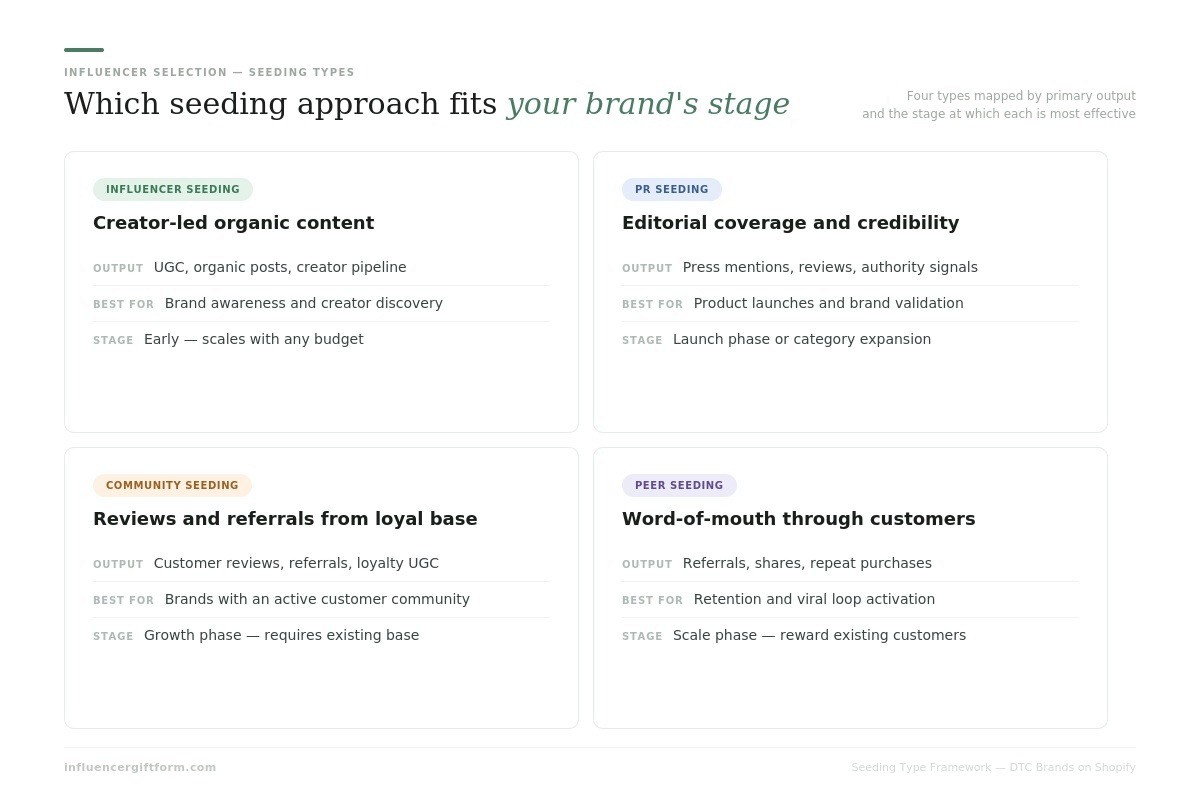
Influencer selection criteria apply most directly to influencer seeding - but the type of seeding program the brand is running shapes which creators belong on the list in the first place.
A seeding marketing program targeting editorial journalists requires different qualification criteria than one targeting UGC (conteúdo gerado pelo usuário) creators on TikTok.
For most DTC brands at early and growth stages, influencer seeding is the right starting point.
It builds content and creator relationships simultaneously and scales without requiring a pre-existing community.
Community and peer seeding become more powerful once the customer base is large enough to activate.
Understanding which type fits the current stage prevents brands from applying the wrong qualification criteria to the wrong channel - and from building a creator list that looks right on paper but performs poorly in practice.
How Influencer Gift Form removes the operational bottleneck after selection
Getting influencer selection right solves the strategic problem. The operational problem - collecting addresses, managing product preferences, creating Shopify orders - is a separate constraint that kills programs at scale regardless of how well the creator list is built.
The standard manual process: reach out via DM, wait for a response, ask for address and size preferences, wait again, copy the details into Shopify, create a $0 order manually, track fulfillment in a spreadsheet.
At 20 sends a month, this is tolerable. At 100, it becomes the primary bottleneck on program growth.
Influencer Gift Form replaces that entire chain with a single secure gifting link. Concretamente, the tool delivers:
Sending a personalized form link to each selected creator - no manual address collection required
Automatically generating $0 Shopify orders based on creator-submitted preferences, with zero copy-paste work
Centralizing tracking for all gifted orders directly inside the existing Shopify dashboard
Eliminating spreadsheets and lost DM threads from the fulfillment workflow
Scaling from 20 to 200+ monthly shipments without increasing headcount or operational complexity
Native integration with the warehouse workflow already running on the Shopify store
For brands that have gone through this transition, the results are consistent with what real Shopify case studies show: programs that previously stalled at 20–30 monthly sends scale past 200 once the operational constraint is removed.
The creator list is the strategy. The gifting form is what lets the strategy run.