7 mistakes in brand deals that kill creator relationships before they start
Discover the most common mistakes in brand deals, why they damage creator relationships, and how DTC brands fix them before they scale.
The most costly mistakes in brand deals rarely happen at the contract stage. They happen earlier - in how a brand approaches a creator, what it sends, how it communicates expectations, and whether it treats the collaboration as a transaction or a relationship.
By the time a creator posts something flat, or nothing at all, the mistake was usually made weeks before.
Brands that consistently get strong results from creator partnerships share one trait: they design the collaboration experience with the same care they give the product.
The ones that struggle treat creators as a distribution channel - and the content reflects it.
The 7 most common mistakes in brand deals and what to do instead
Most of these errors appear reasonable in isolation. The problem is the cumulative effect: a creator who receives a generic outreach, a rigid brief, a product without context, and no follow-up after delivery will not post - and will not respond to the next outreach either.
Choosing creators by follower count instead of audience fit
The most persistent mistake in influencer marketing is also the most expensive. A creator with 500,000 followers and a 0.4% engagement rate consistently underperforms a creator with 25,000 followers and a 4.2% rate - not just on organic content, but on UGC repurposed for paid ads.
Audiences that are genuinely engaged act on recommendations; passive audiences scroll past them.
The metric worth prioritizing is audience fit, not reach. Does the creator's existing content belong in the same world as the product?
Would their audience naturally be interested in what the brand offers? If the answer requires justification, the fit is probably not there.
What to do instead:
Evaluate engagement rate, comment quality, and content consistency before follower count
Look at the creator's existing brand collaborations - does the product category fit naturally?
Check whether the audience demographics match the brand's ICP, not just whether the creator looks right on paper
Sending outreach that reads like a mass email
Creators receive dozens of brand pitches every week. The ones that generate responses feel personal - a specific reference to the creator's content, a clear reason why the brand thinks they are a good fit, and an offer that feels like a genuine gesture rather than a distribution request.
Generic outreach is not just ineffective. It actively signals to the creator that the brand has not done the work, which sets a poor tone for the entire collaboration before it begins.
The outreach message is the first impression of how the brand operates, and creators who receive low-effort pitches share that experience.
Providing a brief so rigid it kills creative authenticity
According to Influencer’s Creator Perspectives Report (in partnership with Crowd DNA), 64% of creators want deeper involvement in brand strategy - not just to execute, but to help shape it.
The content that performs best from influencer collaborations is almost always the content that feels like the creator's own - because it is.
When a brand scripts every sentence, specifies every camera angle, and requires multiple rounds of pre-approval, the resulting content looks exactly like what it is: a paid ad that the creator did not want to make.
A brief that works gives context, not instructions:
The product's key differentiators and the one thing the brand most wants communicated
The audience the brand is trying to reach and why this creator is right for it
Suggested content angles as options, not requirements
What the brand hopes the creator will feel about the product - not what they should say about it
Not disclosing the collaboration clearly
FTC disclosure requirements are not optional, and the consequences of non-compliance fall on both the creator and the brand.
Beyond the legal dimension, undisclosed brand deals erode exactly the trust that makes influencer content valuable in the first place.
Audiences have become increasingly skilled at identifying paid content - and a creator who promotes a product without clear disclosure loses credibility with the audience the brand was paying to reach.
Clear disclosure does not reduce post performance as much as brands fear.
Content that is good enough to be worth watching will be watched whether or not it carries a disclosure label.
Content that needs to hide its commercial nature to feel authentic was never authentic to begin with.
Treating gifting as a one-way transaction
One of the most reliable predictors of whether a creator posts is how the brand behaves after the product ships.
Brands that send a product and go silent have essentially turned gifting into a catalog drop. The creator receives a box, opens it alongside everything else that arrived that week, and moves on.
The brands that consistently generate organic posts from gifting campaigns stay present through the critical window between delivery and the creator's decision to post:
Following the creator and engaging with existing content before the product arrives
Sending a brief, genuine check-in five to seven days after estimated delivery
Responding immediately and authentically when a creator does post - not with a copy-paste brand comment, but with a real reaction
This follow-up behavior is what transforms a product send into the beginning of a relationship. It is also the single most underleveraged lever in creator gifting programs.
Managing gifting logistics manually at scale
A brand deal that begins with a strong pitch and a well-chosen product can still fail at the logistics layer.
The process of collecting creator addresses and product preferences through DM back-and-forth introduces friction that compounds with every send.
At 15 creators a month, it is manageable. At 60, it is a full-time coordination job. At 150, addresses get lost, orders get entered incorrectly, and the operational chaos starts to show in the creator experience.
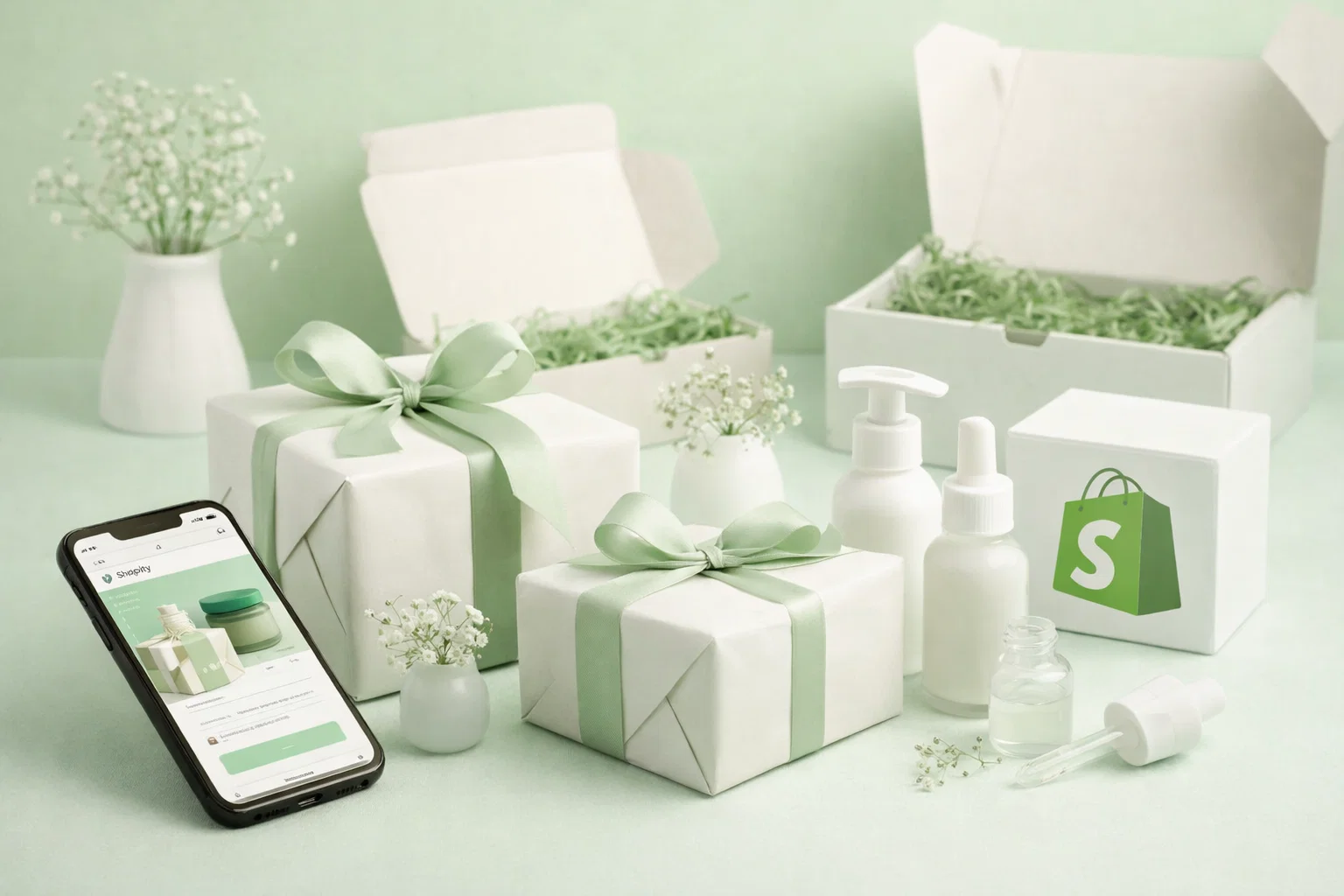
This is precisely the operational problem that Influencer Gift Form was built to solve for Shopify brands. Instead of DM threads and manual $0 order creation, brands send a single secure link.
The creator selects their product preferences, enters their shipping address, and submits. A $0 order is created inside Shopify automatically - no copy-paste, no missed details, no back-and-forth.
For brands running product seeding programs at volume, this operational shift is what allows the program to scale without the creator experience degrading.
Treating every collaboration as a one-off campaign
The brands that lose the most from creator partnerships are the ones that approach every campaign as a standalone project.
They activate creators for a product launch, go silent for three months, then scramble for the next send without building on what they learned.
This stop-start approach wastes up to 40% of potential ROI by failing to build momentum, establish authentic relationships, or carry learnings across campaigns.
The opposite of this is a program mentality - an ongoing, systematic outreach cadence that adds new creators every month and nurtures existing ones toward deeper partnerships over time.
Creators who post organically from a gifting send are the strongest candidates for affiliate programs, brand ambassador pipelines, or paid collaborations.
Treating that first gift as a relationship-opener rather than a one-time transaction is what separates brands building compounding creator equity from those spending the same budget on the same results every quarter.
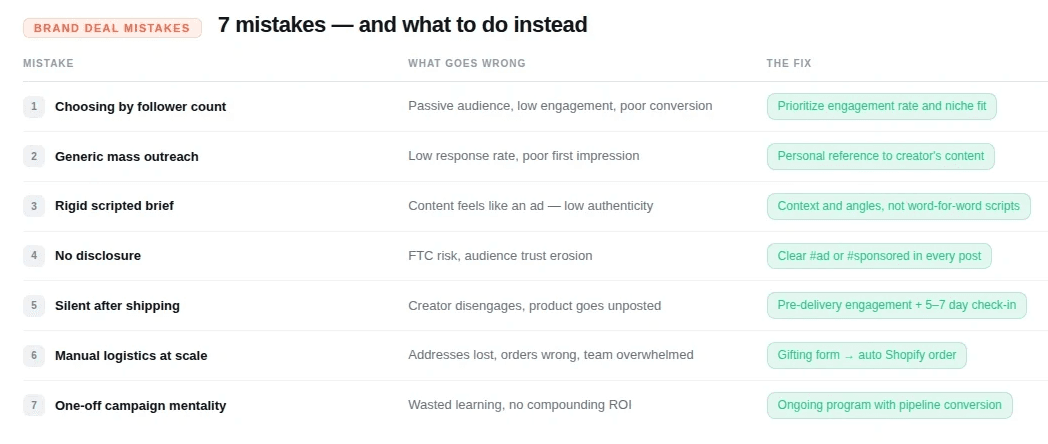
The comparison below maps the seven mistakes against what the correct approach looks like in practice - so the pattern is clear before the next campaign brief gets written.
Wasted learning, no compounding ROI:
How to build brand deals that compound over time
The brands that see the strongest long-term returns from creator partnerships are not necessarily running bigger budgets or working with more creators.
They are running better processes - and the difference between a brand deal that produces a single post and one that opens a six-month relationship almost always comes down to the decisions made before the product ships.
A well-designed brand deal structure looks like this in practice: creator selected for fit, not reach; outreach written specifically for that creator; brief that gives context without scripting; product delivered with a personalized touch; follow-up that treats the creator as a person rather than a channel.
That sequence is not complicated. It just requires intention at each stage.
For brands building gifting programs at volume, the operational layer needs to match that intention.
Influencer Gift Form removes the manual bottlenecks that cause gifting programs to break under volume - address collection, $0 order creation, fulfillment tracking - so the team's energy stays on the relationship layer, not the logistics.
For brands looking at the full picture of how seeding connects to paid creator programs, this guide on product seeding execution covers how to build the infrastructure that turns first gifts into long-term pipelines.
And for brands evaluating which creators are worth sending to in the first place, this breakdown of how to find micro-influencers covers the identification process before the outreach begins.
The mistakes in brand deals that cost the most are not the dramatic ones. They are the structural ones - the generic outreach, the rigid brief, the silence after delivery - that quietly erode the potential of every collaboration before it has a chance to compound.
Fixing them does not require a bigger budget. It requires building the right habits at each stage of the relationship, and the right tools to handle the operational layer at scale.