CPM marketing: what is a good CPM and how to benchmark it by platform
Learn what CPM means in marketing, what counts as a good rate by platform, and how to reduce costs without sacrificing results.

CPM marketing is one of those concepts every digital marketer encounters early - and misreads for longer than they should.
The number itself is simple. What makes it useful or misleading depends entirely on the context around it: the platform, the audience, the objective, and what the impression is actually supposed to produce.
A $9 CPM can represent an efficient buy or a wasted budget, depending on whether the impression is reaching the right person at the right moment.
Understanding that distinction is what separates marketers who optimize CPM from those who just report it.
What CPM means in marketing - and what it does not tell you
CPM stands for cost per mille - "mille" being Latin for one thousand. It measures how much an advertiser pays for every 1,000 impressions their ad receives.
The formula is straightforward: divide total ad spend by total impressions, then multiply by 1,000.
So if a campaign spends $500 and generates 62,500 impressions, the CPM is $8.
CPM is a visibility metric. It tells a brand how much it costs to get the ad in front of eyeballs - not how many of those eyeballs clicked, converted, or remembered the message.
That distinction matters enormously when evaluating whether a CPM is working.
A $4 CPM that reaches an unqualified audience is more expensive than a $14 CPM that reaches buyers already in the consideration stage, because the cost per meaningful outcome is what actually determines efficiency.
CPM is also the underlying currency of almost every paid media auction, even when campaigns are set up as CPC or CPA buys.
Understanding it is foundational to reading influencer marketing ROI and paid media performance together.
The three factors that move CPM up or down
CPM is not a fixed price. It results from an auction where multiple variables determine what each impression costs.
Before benchmarking any number against a platform average, it helps to understand which levers are moving the needle.
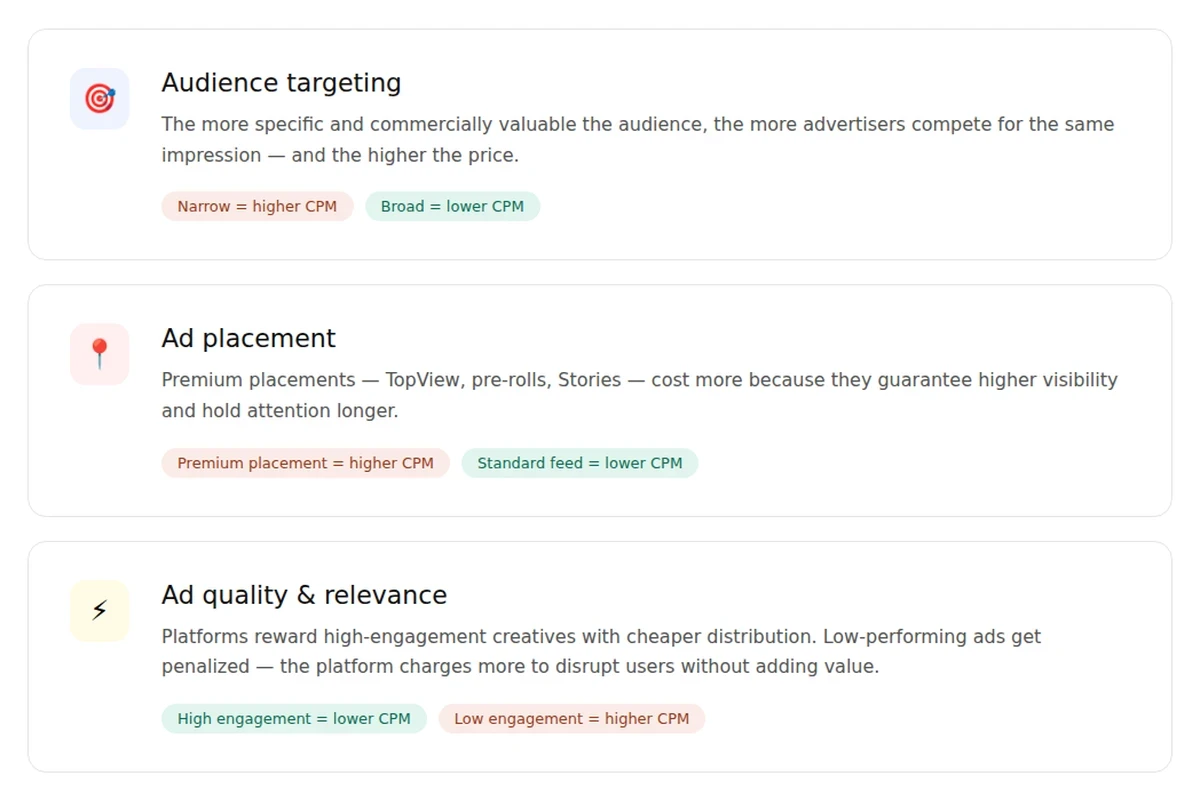
Audience targeting is the most powerful lever. The more specific and commercially valuable the audience, the higher the CPM.
Targeting CFOs aged 35–50 in the SaaS vertical on LinkedIn costs significantly more per thousand impressions than targeting broad interest groups on Facebook - because the audience is rarer and more advertisers are competing for the same attention.
Ad placement is the second lever. Premium placements command premium prices: TikTok TopView, YouTube pre-rolls, and Instagram Stories consistently carry higher CPMs than standard in-feed placements.
The format itself also matters - video ads typically cost more than static images because they hold attention longer and platforms price that attention accordingly.
Ad quality and relevance is the third lever, and the one most advertisers underestimate. Platforms run on engagement signals.
An ad that generates strong watch time, clicks, or saves earns cheaper distribution because it contributes positively to the user experience.
An ad that users scroll past or mute gets penalized with higher CPMs - the platform's way of charging a premium for interrupting without adding value.
These three forces interact constantly. A high-quality creative targeting a broad audience can outperform a mediocre creative targeting a narrow one, both on CPM and on downstream conversions.
Understanding where each factor sits in a given campaign is the starting point for any optimization strategy.
The visual below maps how each factor pushes CPM higher or lower - so the relationship is clear before diving into platform benchmarks.
What pushes your CPM up or down:
What is a good CPM by platform? 2026 benchmarks
Platform benchmarks are the only meaningful reference point for evaluating whether a CPM is competitive.
Without them, a number in isolation tells a marketer nothing - $10 CPM on LinkedIn is an exceptional buy, while the same number on TikTok signals a campaign that needs urgent creative work.
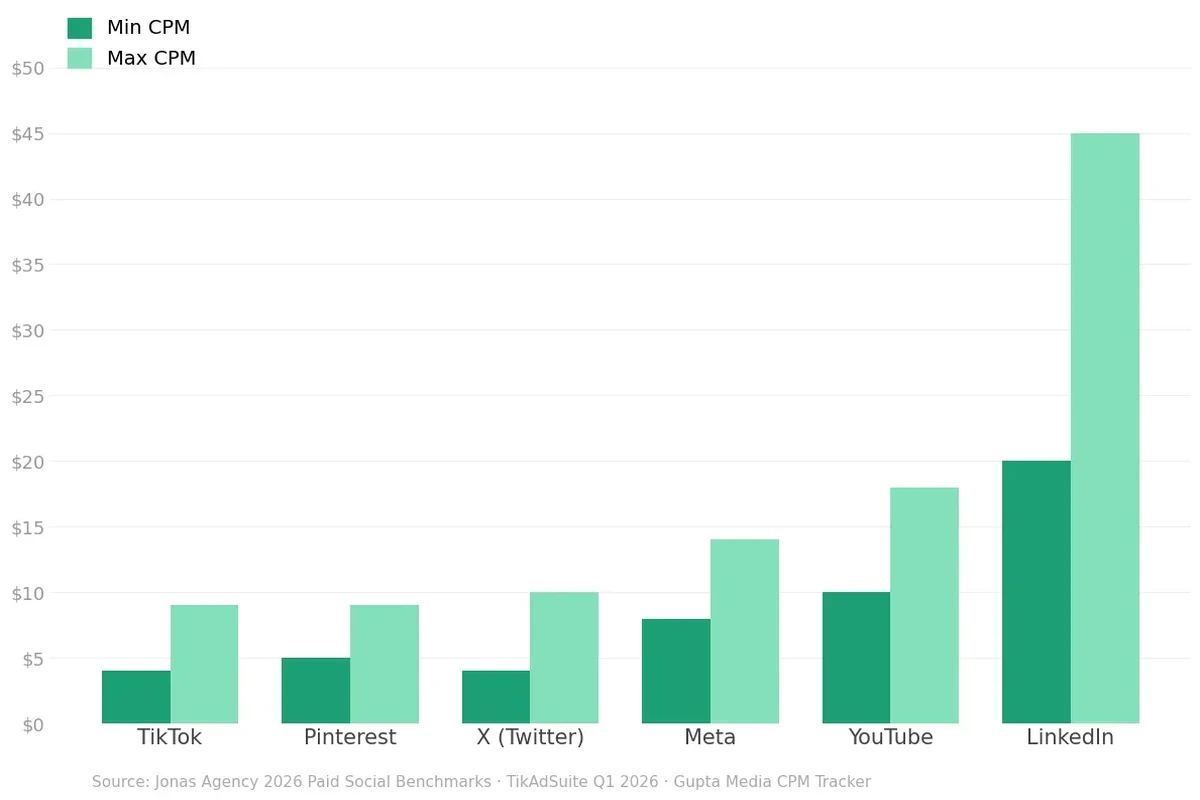
The benchmarks below reflect 2026 data across major platforms for standard placements targeting broad-to-mid audiences. Industry verticals and narrow targeting will push these numbers higher; broad prospecting and low competition periods will pull them lower.
Average CPMs in 2026 vary significantly by platform: TikTok runs $4–8, X (Twitter) $5–10, Meta $8–14, YouTube $10–18, and LinkedIn $20–45. Pinterest sits in the $6–8 range for most consumer categories.
The practical takeaway: TikTok remains the most cost-efficient reach channel for DTC brands targeting younger audiences, while LinkedIn commands a premium that is only justified for B2B targeting where lead quality offsets the higher entry cost.
Every platform benchmark is also a moving target. The average CPM across all social platforms rose 8–12% year-over-year in 2025, a trend driven by increased advertiser competition and the shift toward short-form video formats that carry higher inventory costs.
Brands that locked in audience pools and creative systems earlier are absorbing that inflation better than those still testing.
The chart below puts these benchmarks side by side for easy comparison - including the range within each platform so the numbers reflect real variation rather than a single misleading average.
How seasonality shifts CPM - and when to plan around it
CPM is not static across the calendar year. Advertiser demand fluctuates with consumer behavior, and those fluctuations move prices in predictable patterns that experienced media buyers plan around well in advance.
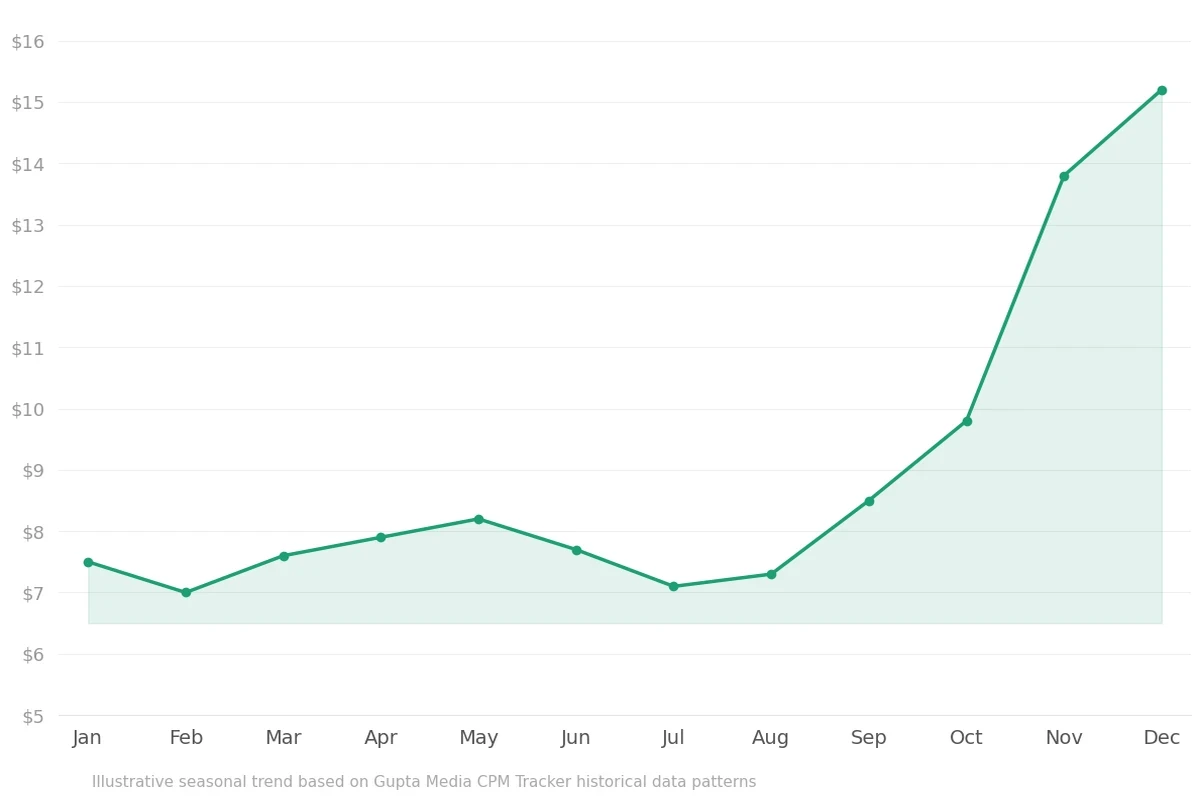
Q4 is the most expensive period across every major platform. Black Friday and the Christmas shopping window drive a surge in advertiser competition that consistently pushes CPMs 30–50% above annual averages.
Brands that have not locked in budgets or creative by October regularly find themselves priced out of efficient placements during the highest-intent shopping weeks of the year.
The summer months - June through August - tend to run the cheapest CPMs of the year as advertiser spend drops and inventory opens up.
This window is consistently underused by DTC brands, despite being one of the best times to run top-of-funnel awareness campaigns at a fraction of the Q4 cost, building the audience pools that retargeting campaigns will convert later.
Event-driven spikes also create short-term CPM volatility - major sporting events, award shows, and viral cultural moments can temporarily inflate costs on specific platforms within hours.
TikTok in particular sees rapid CPM movement during cultural events, because its algorithm prioritizes trending content and advertisers compete to attach to the moment.
The line chart below maps how CPM typically moves across a full calendar year, so the seasonal rhythm is visible before budget planning begins.
Why CPM alone is not a performance metric
A low CPM is a starting condition, not a result. The brands that optimize only for impression cost consistently underperform those that balance CPM against the metrics that actually determine whether a campaign is working.
The most important counterparts to CPM are:
CTR (click-through rate) - measures whether the impression prompted an action. A high CPM with a strong CTR often outperforms a low CPM with a weak one on a cost-per-click basis
Conversion rate - measures whether the clicks from those impressions became customers. This is where platform differences become most consequential: TikTok delivers cheaper impressions than Meta, but Meta consistently shows stronger conversion rates for e-commerce, which explains why many DTC brands run awareness on TikTok and retarget on Meta
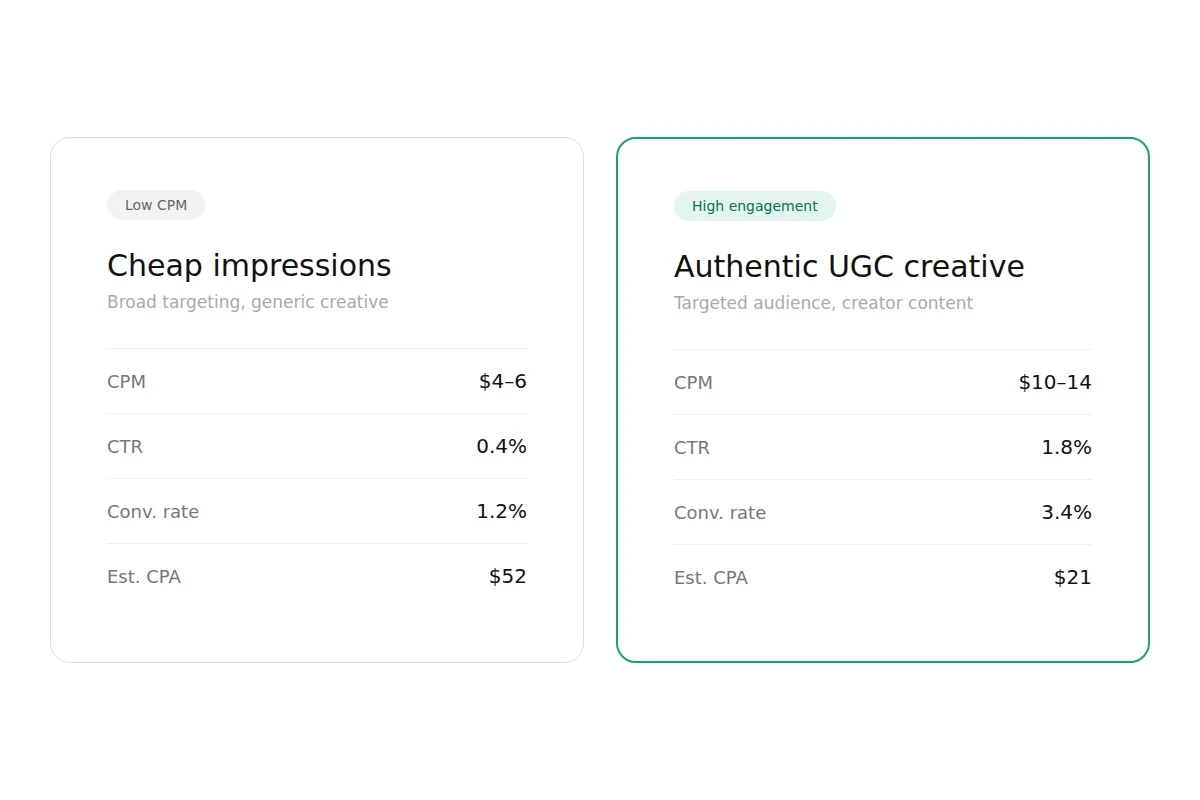
CPA (cost per acquisition) - the most useful downstream metric for evaluating whether a CPM-based buy actually produced business results. A $14 CPM that generates a $22 CPA beats a $6 CPM that generates a $55 CPA, every time
For brands running influencer gifting programs alongside paid media, the relationship between organic creator content and CPM efficiency is increasingly direct.
UGC repurposed as paid ads - Spark Ads on TikTok, whitelisted posts on Meta - consistently outperforms studio-produced creative on both CPM and conversion metrics, because the organic engagement signals carry into the paid distribution.
A creator post that earned authentic engagement before being boosted starts with a quality score advantage that manufactured creative never has.
This is why brands investing in product seeding are building a paid media asset library at the same time - the UGC generated by gifting programs feeds directly into the creative layer that determines ad quality scores and, by extension, CPM efficiency.
The comparison below maps what low-CPM campaigns and high-CPM campaigns actually produce at the conversion level - so the tradeoff is visible before the budget decision gets made.
Low CPM vs. high-engagement CPM - what actually converts:
Using CPM as a starting point, not a destination
CPM marketing is most useful as a diagnostic tool - a way to understand whether a campaign is buying attention efficiently before evaluating whether that attention is converting.
Marketers who treat CPM as the objective miss the downstream metrics that actually determine profitability.
The practical framework is simple: use platform benchmarks to set a reasonable CPM target for the objective, then evaluate creative quality, audience precision, and placement strategy as the levers to hit that target without sacrificing downstream performance.
A campaign running above benchmark CPM is not necessarily failing - it may be targeting a high-value audience where the conversion rate more than compensates for the premium.
For DTC brands building creator-first marketing programs, CPM efficiency and organic creator content are not separate workstreams.
The UGC generated through influencer gifting campaigns consistently outperforms studio creative in paid media - lowering effective CPM while improving conversion rates simultaneously.
Brands that understand this connection build content libraries through gifting programs and deploy that content as paid creative, compounding the return on both investments.